Harmony and hierarchy: A decolonial social psychological analysis of rural community life in Indonesia
DOI:
https://doi.org/10.37905/drsj.v5i1.132Keywords:
Community Norms; Gotong Royong; Relational Self; Rural Indonesia; Social Psychology.Abstract
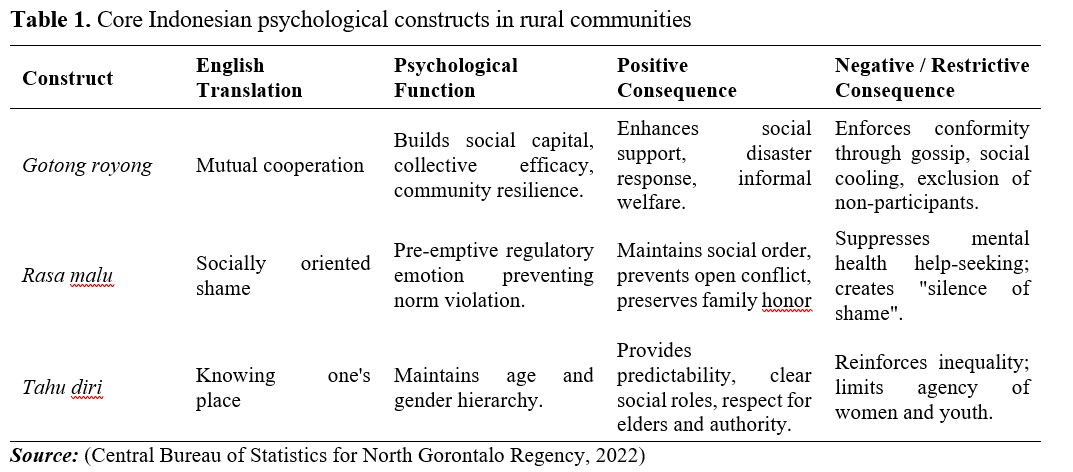
This comprehensive review article analyzes the social psychology of rural community life in Indonesia, examining how cultural ideals of harmony and social hierarchy shape interpersonal behavior, identity formation, and community norms. Despite growing scholarly interest, existing research remains fragmented across disciplines and has not been critically synthesized through a decolonial lens that treats indigenous psychological constructs on their own terms. To address this gap, a systematic literature review was conducted in accordance with the PRISMA 2020 guidelines across the Scopus, Web of Science, PubMed, Google Scholar, and Garuda databases. The inclusion criteria comprised peer-reviewed empirical studies published between 2014 and 2024 that focused on rural Indonesian communities. Thematic synthesis, guided by Braun and Clarke’s (2021) framework and incorporating a decolonial analytical lens, was applied to the 52 included studies. Three main findings emerged. First, gotong royong (mutual cooperation) functions both as a mechanism of social cohesion and as a tool of informal social control. Second, rasa malu (socially oriented shame) operates as a pre-emptive regulatory emotion that enforces conformity but suppresses mental health help-seeking. Third, tahu diri (knowing one’s place) maintains age and gender hierarchies while facing challenges from youth migration and digital media. Theoretically, this review advances understanding by reconceptualizing harmony and hierarchy as integrated, dynamic psychological strategies for navigating interdependent social ecologies. The findings cautiously suggest that community-based, culturally attuned approaches may enhance mental health and development policies, although these implications require further empirical testing through intervention research.
Downloads
References
Allwood, C. M. (2018). The nature and challenges of indigenous psychologies. Social Epistemology, 32(3), 155–169. https://doi.org/10.1080/02691728.2018.1443252
Antlöv, H., Wiranata, I. G. A. W., & Astuti, P. (2016). Village governance and rural development in Indonesia: The new village law. Asian Journal of Social Science, 44(1-2), 5–30. https://doi.org/10.1163/15685314-04401001
Atari, M., Haidt, J., Graham, J., Koleva, S., Stevens, S. T., & Dehghani, M. (2020). Morality beyond the WEIRD: How the nomological network of morality varies across cultures. Journal of Personality and Social Psychology, 119(2), 366–385. https://doi.org/10.1037/pspp0000298
Bennett, L. R. (2005). Women, Islam and modernity: Single women, sexuality and reproductive health in contemporary Indonesia (1st ed.). Routledge. https://doi.org/10.4324/9780203391389
Blackwood, E. (2008). Matrilineal Islam and the politics of gender in West Sumatra. Journal of the Royal Anthropological Institute, 14(2), 325–342. https://doi.org/10.1111/j.1467-9655.2008.00506.x
Braun, V., & Clarke, V. (2021). Thematic analysis: A practical guide. SAGE Publications.
Central Bureau of Statistics [BPS]. (2023). Statistical yearbook of Indonesia 2023. https://www.bps.go.id/publication.html
Central Bureau of Statistics [BPS] for North Gorontalo Regency. (2022). Statistical yearbook of North Gorontalo Regency 2022. Gorontalo: BPS-Statistics Indonesia. https://gorontalo.bps.go.id/publication.html
Creswell, J. W., & Poth, C. N. (2018). Qualitative inquiry and research design: Choosing among five approaches (4th ed.). SAGE Publications.
Enriquez, V. G. (1992). From colonial to liberation psychology: The Philippine experience. University of the Philippines Press.
Geertz, C. (1961). The religion of Java. University of Chicago Press.
Goffman, E. (1959). The presentation of self in everyday life. Doubleday.
Gupta, R., & Azzopardi, C. (2021). Decolonizing psychology: Situating the relational self in community. Journal of Community Psychology, 49(3), 585–598. https://doi.org/10.1002/jcop.22433
Haider, S. (2019). Moral ecology: The rhythms of community life in rural Java. Asian Journal of Social Science, 47(2), 189–213. https://doi.org/10.1163/15685314-04702004
Hasan, N. (2020). The salitization of rural Indonesia. Contemporary Southeast Asia, 42(2), 223–248. https://doi.org/10.1355/cs42-2d
Henrich, J., Heine, S. J., & Norenzayan, A. (2010). The weirdest people in the world? Behavioral and Brain Sciences, 33(2–3), 61–83. https://doi.org/10.1017/S0140525X0999152X
Kusuma, Y. S., & Mahendradhata, Y. (2018). Interpersonal relations and mental health stigma in rural Java. Asian Journal of Psychiatry, 36, 23–29. https://doi.org/10.1016/j.ajp.2018.07.002
Latief, H. (2021). Inclusion and exclusion in Indonesia's rural communities: The case of migrant settlers. Journal of Current Southeast Asian Affairs, 40(1), 75–95. https://doi.org/10.1177/186810342199426
Lockwood, C., Munn, Z., & Porritt, K. (2020). Qualitative research synthesis: Methodological guidance for systematic reviewers utilizing meta-aggregation. JBI Evidence Implementation, 18(3), 320–329. https://doi.org/10.1097/XEB.0000000000000220
Lyon, B., & Iskandar, P. (2024). Relational self and farmworker law reform: The case of Indonesia. Legal Pluralism and Critical Social Analysis, 56(3), 616–636. https://doi.org/10.1080/27706869.2024.2374631
Mahshunah, N. R., Padmaningrum, D., & Widiyanti, E. (2024). The influence of vicarious experience and social persuasion on the self-efficacy of millennial farmers. Jurnal Sosial Ekonomi Pertanian, 20(3), 307–315. https://doi.org/10.20956/jsep.v20i3.36666
Markus, H. R., & Kitayama, S. (1991). Culture and the self: Implications for cognition, emotion, and motivation. Psychological Review, 98(2), 224–253. https://doi.org/10.1037/0033-295X.98.2.224
Mead, G. H. (1934). Mind, self, and society. University of Chicago Press.
Mulder, N. (1996). Inside Indonesian society: Cultural change in Java. Pepin Press.
Nelson, G., & Prilleltensky, I. (2010). Community psychology: In pursuit of liberation and well-being (2nd ed.). Palgrave Macmillan. https://doi.org/10.1007/978-0-230-37008-1
Nilan, P. (2017). Youth, morality, and digital media in Indonesia. Journal of Youth Studies, 20(8), 1047–1063. https://doi.org/10.1080/13676261.2017.1287888
Nilan, P., Demartoto, A., & Wibowo, A. (2021). Digital duality: Youth identity and social media in rural Indonesia. Journal of Sociology, 57(3), 644–662. https://doi.org/10.1177/144078332199040
Page, M. J., McKenzie, J. E., Bossuyt, P. M., et al. (2021). The PRISMA 2020 statement: An updated guideline for reporting systematic reviews. BMJ, 372, Article n71. https://doi.org/10.1136/bmj.n71
Prawira, H. (2019). Shame and silence: Gendered responses to conflict in rural Indonesia. Asian Journal of Social Psychology, 22(3), 250–262. https://doi.org/10.1111/ajsp.12357
Rakhmani, I., & Tarman, B. (2022). Gotong royong as social infrastructure in the digital age. South East Asia Research, 30(1), 108–126. https://doi.org/10.1080/0967828X.2022.2036456
Riasnugrahani, M., Setiawan, T., de Jong, E., & Takwin, B. (2024). A dual pathway for understanding the relation between wellbeing and resilience. Humanities & Social Sciences Communications, 11, Article 937. https://doi.org/10.1057/s41599-024-03440-4
Setijaningrum, E., Triana, R. W., & Kassim, A. (2024). Thriving through time: Resilience and empowerment for aging women in rural Indonesia. Journal of International Women's Studies, 26(4), Article 11. https://vc.bridgew.edu/jiws/vol26/iss4/11
Smith, J. A., & Porath, M. (2020). Indigenous psychology in Southeast Asia: A systematic review. Culture & Psychology, 26(4), 679–700. https://doi.org/10.1177/1354067X2090724
Snyder, H. (2019). Literature review as a research methodology: An overview and guidelines. Journal of Business Research, 104, 333–339. https://doi.org/10.1016/j.jbusres.2019.07.039
Stevenson, R., & Nurmala, I. (2019). Cultural scripts and expressions of distress in Indonesia. Transcultural Psychiatry, 56(4), 632–654. https://doi.org/10.1177/1363461519860287
Suwignyo, A. (2017). Gotong royong as social citizenship in Indonesia. Journal of Southeast Asian Studies, 48(3), 381–406. https://doi.org/10.1017/S0022463417000565
Tajfel, H., & Turner, J. C. (1979). An integrative theory of intergroup conflict. In W. G. Austin & S. Worchel (Eds.), The social psychology of intergroup relations (pp. 33-47). Brooks/Cole.
Wardhani, R., & Fauk, N. K. (2020). Cultural adaptation of mental health interventions in rural Indonesia: A review. International Journal of Mental Health Systems, 14, Article 34. https://doi.org/10.1186/s13033-020-00372-5
Wijayanto, A. (2022). The digital panopticon? Social media and surveillance in a Javanese village. Media, Culture & Society, 44(5), 865–881. https://doi.org/10.1177/016344372110406
Wikan, U. (1990). Managing turbulent hearts: A Balinese formula for living. University of Chicago Press.
Wind, A., & Komariah, S. (2021). Community-based mental health care in Indonesia: A case for cultural safety. The Lancet Psychiatry, 8(2), 106–108. https://doi.org/10.1016/S2215-0366(20)30486-4
Downloads
Published
How to Cite
Issue
Section
License
Copyright (c) 2026 Gautam Makwana

This work is licensed under a Creative Commons Attribution-NonCommercial 4.0 International License.



.png)