Governance fragmentation and food security in South Africa’s Upper Umzimvubu River catchment: A network governance perspective
DOI:
https://doi.org/10.37905/drsj.v5i1.147Keywords:
Communal Land, Food Security, Network Governance, Rural LivelihoodsAbstract
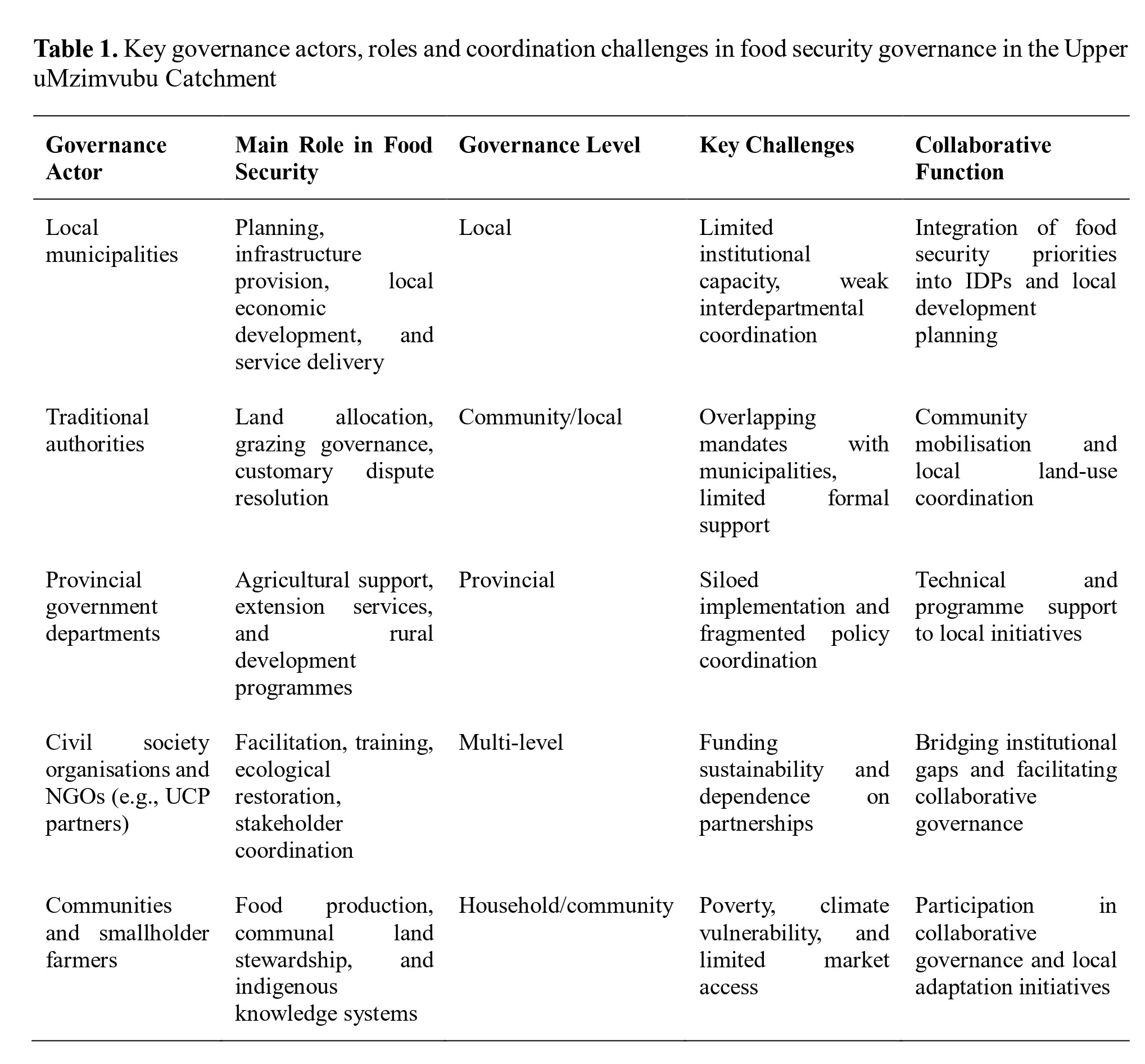
The Upper uMzimvubu River catchment in South Africa’s Eastern Cape faces persistently low food productivity, driven by land degradation and the escalating impacts of climate change. This study investigates how governance dynamics shape food security outcomes on rural communal land, focusing on the potential of collaborative, multi-level, and networked governance approaches to address systemic vulnerabilities and enhance local food production. Using a review-based methodology grounded in both empirical insights and scholarly literature on food governance, the research applies a network governance framework to examine how state and non-state actors coordinate interventions in the food security landscape. The findings indicate that food insecurity in the catchment arises not only from environmental and socio-economic stressors but is also exacerbated by fragmented governance, policy incoherence, and institutional weaknesses. In this context, civil society networks play a central role in polycentric governance, often bridging gaps left by formal institutions. The study advocates a decentralised, participatory, and integrated model of food security governance, emphasising secure land tenure, climate-resilient development planning, and improved coordination among diverse stakeholders. By integrating perspectives from environmental governance, rural development, and land tenure studies, this research provides a transdisciplinary lens on food insecurity. It demonstrates how combining policy analysis, local knowledge, and institutional theory can foster collaboration among academics, policymakers, and civil society actors, ultimately enabling more effective responses to the complex challenges of rural food insecurity in South Africa.
Downloads
References
Allain-Dupré, D. (2020). The multi-level governance imperative. The British Journal of Politics and International Relations, 22(4), 800–808. https://doi.org/10.1177/1369148120937984
Archer, S. R., Andersen, E. M., Predick, K. I., Schwinning, S., Steidl, R. J., & Woods, S. R. (2017). Woody plant encroachment: Causes and consequences. In D. Briske (Ed.), Rangeland systems (pp. 25–84). Springer. https://doi.org/10.1007/978-3-319-46709-2_2
Bado, V. B., & Bationo, A. (2018). Integrated management of soil fertility and land resources in Sub-Saharan Africa: Involving local communities. Advances in Agronomy, 150, 1–33. https://oar.icrisat.org/10789/1/bs.agron.2018.02.001.pdf
Candel, J. J. (2014). Food security governance: A systematic literature review. Food Security, 6(4), 585–601. https://doi.org/10.1007/s12571-014-0364-2
Candel, J. J., & Pereira, L. (2017). Towards an integrated food policy: Main challenges and steps ahead. Environmental Science & Policy, 73, 89–92. https://doi.org/10.1016/j.envsci.2017.04.010
Conradie, B., Matthews, N., & Bahta, Y. (2024). Benefits of herding on communal rangelands in Free State Province, South Africa. South African Journal of Agricultural Extension, 52(5), 36–52. https://doi.org/10.17159/2413-3221/2024/v52n5a14651
Conservation South Africa. (2015). Alfred Nzo District Municipality climate change response strategy (Technical report). Alfred Nzo District Municipality. https://doi.org/10.13140/RG.2.2.25753.93282
Cousins, B. (2013). Smallholder irrigation schemes, agrarian reform, and ‘accumulation from above and from below’ in South Africa. Journal of Agrarian Change, 13(1), 116–139. https://doi.org/10.1111/joac.12000
Drimie, S., & Ruysenaar, S. (2010). The integrated food security strategy of South Africa: An institutional analysis. Agrekon, 49(3), 316–337. https://doi.org/10.1080/03031853.2010.503377
Environmental and Rural Solution (ERS), & Conservation South Africa. (2011). Umzimvubu Catchment overview draft 2. https://umzimvubu.files.wordpress.com/2014/09/umzimvubu-summary-report-dec-2011.pdf
Kruger, E. (2016). Appendix 3: Matatiele annual report: Conservation Agriculture Farmer Innovation Programme (CA FIP) for smallholders, Grain SA, July 2015 to September 2016: Farmer centred innovation in conservation agriculture in upper catchment areas of the Drakensberg, Eastern Cape. Mahlathini Development Foundation. https://www.mahlathini.org/pdfdata/ae99c1669ba03fbc1e4f7e0e4560c55d/pdf.pdf
Fabricius, C., & Koch, E. (2004). Rights, resources and rural development: Community-based natural resource management in Southern Africa. Routledge. https://doi.org/10.4324/9781849772433
FAO. (2020). Status of the World’s Soil Resources. Food and Agriculture Organisation of the United Nations. https://www.fao.org/3/a-i5199e.pdf
Favretto, N., Shackleton, S., Sallu, S. M., Gordon, C., Methner, N., Outa, G., … Williams, P. A. (Eds.). (2021). Collaboration and multi-stakeholder engagement in landscape governance and management in Africa: Lessons from practice. MDPI. https://doi.org/10.3390/books978-3-0365-1478-9
Fetoui, M., Frija, A., Dhehibi, B., Sghaier, M., & Sghaier, M. (2021). Prospects for stakeholder cooperation in the effective implementation of enhanced rangeland restoration techniques in southern Tunisia. Rangeland Ecology & Management, 74, 9–20. https://doi.org/10.1016/j.rama.2020.10.006
Greenberg, S., Drimie, S., Losch, B., & Jila, N. (2022). Agroecological initiatives in South Africa: Lessons and recommendations from three study sites. TAFS phase 2, Synthesis report. https://www.southernafricafoodlab.org/transitions-to-agroecological-food-systems/
Hardin, G. (1968). The tragedy of the commons. Science, 162(3859), 1243–1248. http://www.jstor.org/stable/1724745
Hendriks, S. (2013). South Africa's National Development Plan and New Growth Path: Reflections on policy contradictions and implications for food security. Agrekon, 52(3), 1–17. https://doi.org/10.1080/03031853.2013.821741
Hendriks, S. (2014). Food security in South Africa: Status quo and policy imperatives. Agrekon, 53(2), 1–24. https://doi.org/10.1080/03031853.2014.915468
Kapucu, N., Hu, Q., Sadiq, A. A., & Hasan, S. (2023). Building urban infrastructure resilience through network governance. Urban Governance, 3(1), 5–13. https://doi.org/10.1016/j.ugj.2023.01.001
Klijn, E. H., & Koppenjan, J. (2016). Governance networks in the public sector. Routledge. https://doi.org/10.4324/9781315887098
Kotschy, K., & Pollard, S. (2022). Final report mid-term evaluation of WWF-SA’s Eastern Cape Drakensberg Water Source Areas Work. WWF.
Kushitor, S. B., Drimie, S., Davids, R., Delport, C., Hawkes, C., Mabhaudhi, T., … Pereira, L. M. (2022). The complex challenge of governing food systems: The case of South African food policy. Food Security, 14(4), 883–896. https://doi.org/10.1007/s12571-022-01258-z
Lægreid, P., & Rykkja, L. H. (2022). Accountability and inter-organisational collaboration within the state. Public Management Review, 24(5), 683–703. https://doi.org/10.1080/14719037.2021.1963822
Lück-Vogel, M., Pieterse, A., Chilwane, L., & van Niekerk, W. (2024). Alfred Nzo Municipality: Adaptation Plan. Climate and Disaster Resilience Fund, Santam & Alfred Nzo Municipality. CSIR. https://greenbook.co.za/documents/AlfredNzo_AdaptationPlan_Jul2024.pdf
Lyne, M. C., Jonas, N., & Ortmann, G. F. (2018). A quantitative assessment of an outsourced agricultural extension service in the Umzimkhulu District of KwaZulu-Natal, South Africa. Journal of Agricultural Education and Extension, 24(1), 51–64. https://doi.org/10.1080/1389224X.2017.1387159
Masiza, W., Hamandawana, H., Chirima, J. G., Khoboko, P., & Parkies, N. (2023). The extent and perceived causes and impacts of land use and land cover change in Tyhume Valley, South Africa. Frontiers in Conservation Science, 4, 1205750. https://doi.org/10.3389/fcosc.2023.1205750
Matatiele Local Municipality. (2021). Adopted 2021/22 Integrated Development Plan Review [Technical report]. Matatiele Local Municipality. https://www.matatiele.gov.za/document/adopted-2021-2022-idp-summary/
Matela, S., & McLeod, N. (2016). Landscapes and livelihoods: A communal rangeland stewardship model—Model summary and toolkit guide (UCPP Rangeland Restoration Toolkit). Critical Ecosystem Partnership Fund, Conservation South Africa, & Umzimvubu Catchment Partnership Programme. https://umzimvubu.org/wp-content/uploads/2016/07/rangeland-restoration-toolkit-executive-summary-feb2016-ucpp.pdf
Matela, S., McLeod, N., Mubangizi, B., Zunckel, K., Randera-Rees, S., Kuse, M., & Kuali, T. G. (2023). Guidelines for enhanced communal landscape governance [Technical report, Project C2022/2023/00882]. Water Research Commission. https://sarchichair-slh.ukzn.ac.za/wp-content/uploads/2025/01/WRC-Report.pdf
Maziya, M., Mudhara, M., & Chitja, J. (2017). What factors determine household food security among smallholder farmers? Insights from Msinga, KwaZulu-Natal, South Africa. Agrekon, 56(1), 40–52. https://doi.org/10.1080/03031853.2017.1283240
Mbele, S., & Mubangizi, B. C. (2023). Rural communities and water governance: Understanding participatory processes for catchment management in the Upper Umzimvubu Catchment. International Journal of Environmental, Sustainability, and Social Science, 4(5), 1416–1425. https://doi.org/10.38142/ijesss.v4i5.587
Mkhongi, F. A., Musakwa, W., & Mokhele, T. (2024). Household food security contextualised: A comparison of Ambros and Maramanzhi villages, South Africa. Heliyon, 10(21), e39971. https://doi.org/10.1016/j.heliyon.2024.e39971
Mubangizi, B. C. (2013). Good governance and food security in South Africa: Opportunities for local government. Loyola Journal of Social Sciences, 27(2), 175–193.
Mubangizi, B. C. (2021). Rural livelihoods in South Africa: Mapping the role-players. Administratio Publica, 29(4), 17–32. https://journals.co.za/doi/abs/10.10520/ejc-adminpub_v29_n4_a3
Mubangizi, B. C. (2024). Network governance for sustainable rural livelihoods: Lessons from rural areas of Uganda and South Africa. African Journal of Development Studies, 14(1). https://hdl.handle.net/10520/ejc-aa_affrika1_v14_n1_a1
Ngcamu, B. S., & Chari, F. (2020). Drought influences on food insecurity in Africa: A systematic literature review. International Journal of Environmental Research and Public Health, 17(16), 5897. https://doi.org/10.3390/ijerph17165897
Ojogiwa, O. T., & Mubangizi, B. (2023). Navigating the complex terrain of food security in decentralised systems: Insights from South Africa and Nigeria. African Journal of Governance and Development, 12(2), 141–160. https://doi.org/10.36369/2616-9045/2023/v12i2a9
Ostrom, E. (1990). Governing the commons: The evolution of institutions for collective action. Cambridge University Press. https://doi.org/10.1017/CBO9780511807763
Reed, M. S., Stringer, L. C., Fazey, I., Evely, A. C., & Kruijsen, J. H. (2014). Five principles for the practice of knowledge exchange in environmental management. Journal of Environmental Management, 146, 337–345. https://doi.org/10.1016/j.jenvman.2014.07.021
Scholes, R., Montanarella, L., Brainich, A., Barger, N., ten Brink, B., Cantele, M., Erasmus, B., Fisher, J., Gardner, T., Holland, T. G., Kohler, F., Kotiaho, J. S., Von Maltitz, G., Nangendo, G., Pandit, R., Parrotta, J., Potts, M. D., Prince, S., Sankaran, M., & Willemen, L. (Eds.). (2018). Summary for policymakers of the assessment report on land degradation and restoration of the Intergovernmental Science-Policy Platform on Biodiversity and Ecosystem Services. IPBES Secretariat. https://research.fs.usda.gov/treesearch/58402
Sibiya, S., Clifford-Holmes, J. K., & Gambiza, J. (2023). Drivers of degradation of croplands and abandoned lands: A case study of Macubeni communal land in the Eastern Cape, South Africa. Land, 12(3), 606. https://doi.org/10.3390/land12030606
Slayi, M., Zhou, L., Thamaga, K. H., & Nyambo, P. (2024). The role of social inclusion in restoring communal rangelands in Southern Africa: A systematic review of approaches, challenges, and outcomes. Land, 13(9), 1521. https://doi.org/10.3390/land13091521
Snorek, J. L., Loos, J. R., Cox, M., Shata, T., Bowman, A. Q., Kramer, J. C., … Krivak-Tetley, F. (2022). Care-based leadership in a core-periphery network: A South African case study in collaborative watershed governance. Ecology and Society, 27(4). https://doi.org/10.5751/ES-13589-270434
Stanway, R. (2016). Meat Naturally Initiative: embedding sustainability into South Africa's emerging red meat sector: Research & training. Red Meat/Rooivleis, 7(5), 89–91. https://hdl.handle.net/10520/EJC196209
Turpie, J. K., Marais, C., & Blignaut, J. N. (2008). The Working for Water programme: Evolution of a payments for ecosystem services mechanism that addresses both poverty and ecosystem service delivery in South Africa. Ecological Economics, 65(4), 788–798. https://doi.org/10.1016/j.ecolecon.2007.12.024
Van Tol, J., Franke, L., & Le Roux, J. (2023). Soil erosion: Southern Africa's water tower is endangered. Global Food Journal. https://www.welthungerhilfe.org/global-food-journal/rubrics/agricultural-food-policy/the-danger-of-soil-erosion-in-southern-africa
Vanlauwe, B., Coyne, D., Gockowski, J., Hauser, S., Huising, J., Masso, C., Nziguheba, G., & Schut, M. L. W. (2014). Sustainable intensification and the African smallholder farmer. Current Opinion in Environmental Sustainability, 8, 15–22. https://doi.org/10.1016/j.cosust.2014.06.001
Vervoort, J. M., Thornton, P. K., Kristjanson, P., Förch, W., Ericksen, P. J., Kok, K., … Jost, C. (2014). Challenges to scenario-guided adaptive action on food security under climate change. Global Environmental Change, 28, 383–394. https://doi.org/10.1016/j.gloenvcha.2014.03.001
Wang, L., Müller, R., & Zhu, F. (2023). Network governance for interorganizational temporary organisations: A systematic literature review and research agenda. Project Management Journal, 54(1), 35–51. https://doi.org/10.1177/87569728221125924
Zantsi, S., & Nengovhela, R. (2022). A review of the land reform beneficiary training in South Africa: The role of agricultural extension. South African Journal of Agricultural Extension, 50(1), 163–177. https://doi.org/10.17159/2413-3221/2022/v50n1a11283
Zembe, A., Nemakonde, L. D., & Chipangura, P. (2023). Institutional mechanism for policy coherence between climate change adaptation, disaster risk reduction and food security in South Africa. International Journal of Agricultural Resources, Governance and Ecology, 18(4), 368–388. https://doi.org/10.1504/IJARGE.2022.128254
Downloads
Published
How to Cite
Issue
Section
License
Copyright (c) 2026 Betty Claire Mubangizi

This work is licensed under a Creative Commons Attribution-NonCommercial 4.0 International License.




.png)