Navigating fear and coexistence: The social costs of crocodile threats in the Gin Ganga River, Nagoda Divisional Secretariat, Galle District, Sri Lanka
DOI:
https://doi.org/10.37905/drsj.v5i1.164Keywords:
Conflict, Crocodile Threats, Fear, Gin Ganga, Social CostAbstract
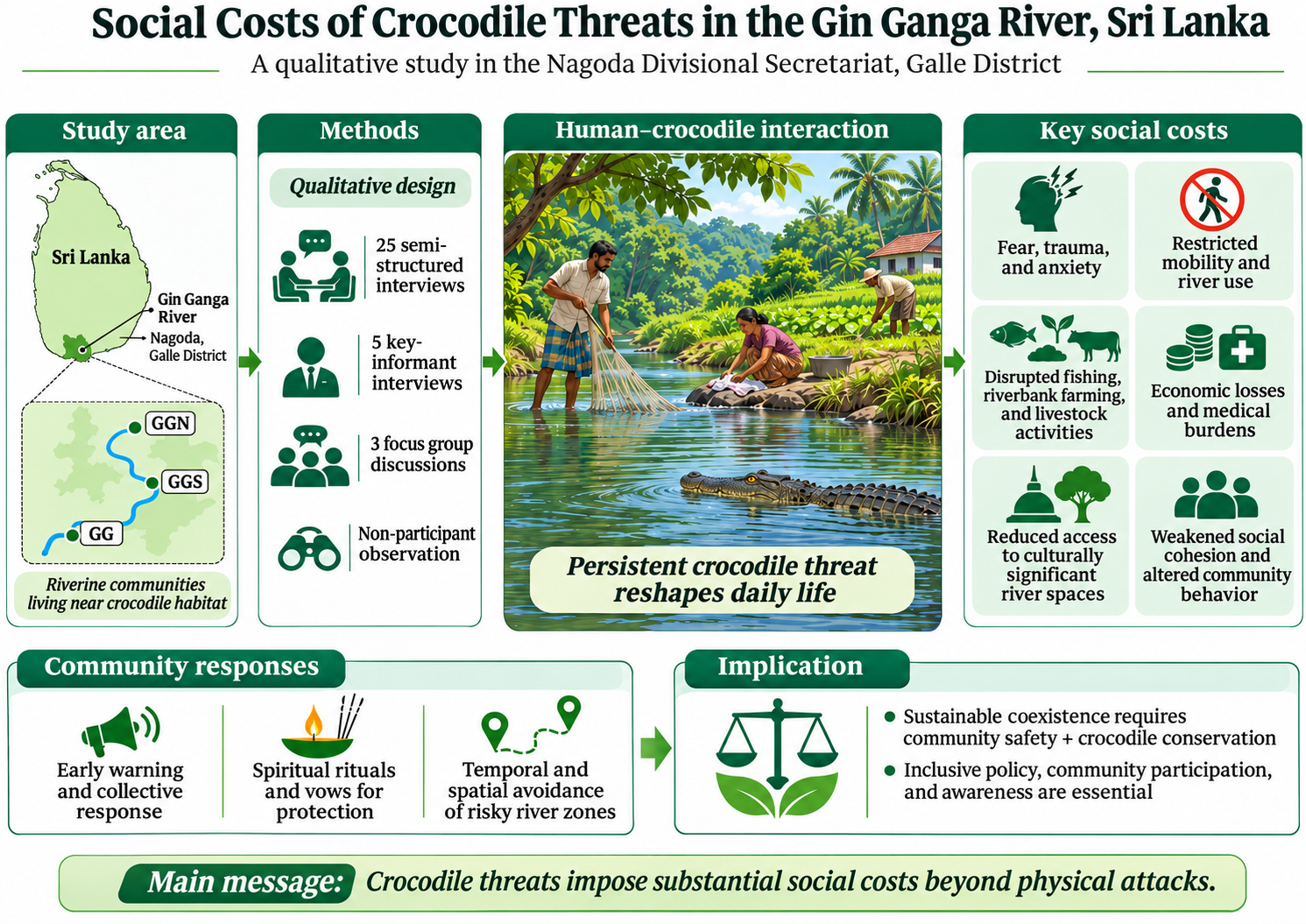
Human–crocodile conflict is a significant conservation and social issue worldwide. In Sri Lanka, such conflicts primarily involve saltwater crocodile and mugger crocodile populations inhabiting major river systems, including the Nilwala and Gin Ganga rivers and their surrounding wetlands. This study investigates the social costs associated with crocodile-related conflict, focusing on its implications for human safety, livelihoods, cultural practices, and community well-being. Drawing on the Social–Ecological Systems framework and Human–Wildlife Conflict Theory, this study examines the economic, psychological, and social dimensions of conflict while emphasizing the importance of incorporating local perceptions into conservation strategies. A qualitative research design was employed to explore the experiences of communities living along the Gin Ganga River in the Nagoda Divisional Secretariat, Galle District, Sri Lanka. Data were collected through semi-structured interviews, focus group discussions, and participant observation to obtain in-depth insights into community experiences. The findings indicate that the persistent threat of crocodile encounters generates fear and restricts mobility, disrupting daily activities and local livelihoods, particularly fishing, small-scale agriculture along riverbanks, and livestock-related activities. Beyond immediate physical risks, crocodile-related conflict contributes to substantial psychosocial distress, weakens social cohesion, limits access to culturally significant river spaces, and constrains traditional practices and educational activities. The river, once perceived as a source of sustenance and comfort, has increasingly become associated with fear and insecurity, creating considerable yet often overlooked social burdens for affected communities. The study concludes that addressing human–crocodile conflict requires a balanced approach that integrates wildlife conservation with community safety and promotes sustainable coexistence through inclusive policies, community participation, and awareness initiatives.
Downloads
References
Abdul Gani, M. I. Z., Hassan, R., Tisen, O. B., & Ahmad, R. (2022). Human-crocodile conflicts in Sarawak, Malaysian Borneo: An analysis of crocodile attacks from 2000 until 2020. International Journal of Biology and Biomedical Engineering, 16, 186–195. https://doi.org/10.46300/91011.2022.16.25
Amarasinghe, A. A. T., Madawala, M. B., Karunarathna, D. M. S. S., Manolis, S. C., de Silva, A., & Sommerlad, R. (2015). Human-crocodile conflict and conservation implications of saltwater crocodiles Crocodylus porosus (Reptilia: Crocodylia: Crocodylidae) in Sri Lanka. Journal of Threatened Taxa, 7(5), 7111–7130. https://doi.org/10.11609/JoTT.o4159.7111-30
Ashepet, M.-G., Dahdouh-Guebas, F., Redpath, S., Pooley, S., & Huge, J. (2024). The state and perceptions of human-crocodile interactions around Murchison falls conservation area, Uganda. Human Dimensions of Wildlife, 29(2), 194–209. https://doi.org/10.1080/10871209.2023.2212692
Barua, M., Bhagwat, S. A., & Jadhav, S. (2013). The hidden dimensions of human–wildlife conflict: Health impacts, opportunity and transaction costs. Biological Conservation, 157, 309–316. https://doi.org/10.1016/j.biocon.2012.07.014
Benansio, J. S., Demaya, G. S., Dendi, D., & Luiselli, L. (2022). Attacks by Nile crocodiles (Crocodylus niloticus) on humans and livestock in the Sudd Wetlands, South Sudan. Russian Journal of Herpetology, 29(4), 199–205. https://doi.org/10.30906/1026-2296-2022-29-4-199-205
Benansio, J. S., Damaya, G. S., Funk, S. M., Fa, J. E., Di Vittorio, M., Dendi, D., & Luiselli, L. (2024). Attitudes and perceptions of local communities towards Nile crocodiles (Crocodylus niloticus) in the Sudd Wetlands, South Sudan. Animals, 14(12), Article 1819. https://doi.org/10.3390/ani14121819
Chakanyuka, T., & Utete, B. (2022). Adaptive co-management, co-existence or just wildlife conservation? Case study of the human and Nile crocodile (Crocodylus niloticus) conflicts in Ngezi Dam, Mashonaland West, Zimbabwe. African Journal of Ecology, 60(3), 759–768. https://doi.org/10.1111/aje.12974
Chakuya, J., & Gondo, R. (2018). The human crocodile conflicts and the sustainable conflict resolutions review. International Journal of Environmental Sciences & Natural Resources, 13(2), 30–37. https://doi.org/10.19080/IJESNR.2018.13.555856
Crocodile Specialist Group. (n.d.). Human-crocodile conflict. IUCN-SSC Crocodile Specialist Group. https://www.iucncsg.org/pages/Human%2dCrocodile-Conflict.html
De Alwis, D., & Noy, I. (2019). The cost of being under the weather: Droughts, floods, and health-care costs in Sri Lanka. Asian Development Review, 36(2), 185–214. https://doi.org/10.1162/adev_a_00136
Dickman, A. J. (2010). Complexities of conflict: The importance of considering social factors for effectively resolving human–wildlife conflict. Animal Conservation, 13(5), 458–466. https://doi.org/10.1111/j.1469-1795.2010.00368.x
Graneheim, U. H., & Lundman, B. (2004). Qualitative content analysis in nursing research: Concepts, procedures and measures to achieve trustworthiness. Nurse Education Today, 24(2), 105–112. https://doi.org/10.1016/j.nedt.2003.10.001
Jayarathne, S. D. Y., Nahallage, C. A. D., & Huffman, M. A. (2025). The costs of living side-by-side with monkeys: Economic impacts on commercial farms and property by toque macaques and proposed deterrent strategies in a rural agriculture area of Kurunegala District, Sri Lanka. Animals, 15(3), Article 366. https://doi.org/10.3390/ani15030366
Karanth, K. K., & Nepal, S. K. (2012). Local residents perception of benefits and losses from protected areas in India and Nepal. Environmental Management, 49(2), 372–386. https://doi.org/10.1007/s00267-011-9778-1
Karawita, K. V. D. H. R., Fernando, K. R. A. W., Illukkumbura, K. M. T. W., Wijenanda, K. R. A. T., Rathnayaka, K. W. A. M. A. G. T. M., & Kulathunga, G. H. D. D. (2025). Human-crocodile conflict in the Nilwala River Basin: Socio-economic impacts on flood-prone communities. Proceedings of International Forestry and Environment Symposium, 29. https://doi.org/10.31357/fesympo.v29.8156
Laundré, J. W., Hernández, L., & Ripple, W. J. (2010). The landscape of fear: Ecological implications of being afraid. The Open Ecology Journal, 3(3), 1–7. https://doi.org/10.2174/1874213001003030001
Matanzima, J., Marowa, I., & Nhiwatiwa, T. (2023). Negative human–crocodile interactions in Kariba, Zimbabwe: Data to support potential mitigation strategies. Oryx, 57(4), 452–456. https://doi.org/10.1017/S003060532200014X
Mbaiwa, J. E. (2018). Effects of the safari hunting tourism ban on rural livelihoods and wildlife conservation in Northern Botswana. South African Geographical Journal, 100(1), 41–61. https://doi.org/10.1080/03736245.2017.1299639
Nyhus, P. J. (2016). Human–wildlife conflict and coexistence. Annual Review of Environment and Resources, 41, 143–171. https://doi.org/10.1146/annurev-environ-110615-085634
Ojeda Adame, R. A., Chávez Dagostino, R. M., Gerritsen, P. R. W., Aguilar Olguín, S., & Íñiguez Dávalos, L. I. (2023). Estado del arte sobre la relación conflictiva del humano con el cocodrilo. Teoría y Praxis, 31, 30–39. https://doi.org/10.22403/UQROOMX/TyP31/04
Ostrom, E. (2009). A general framework for analyzing sustainability of social-ecological systems. Science, 325(5939), 419–422. https://doi.org/10.1126/science.1172133
Pooley, S., Barua, M., Beinart, W., Dickman, A., Holmes, G., Lorimer, J., Loveridge, A. J., Macdonald, D. W., Marvin, G., Redpath, S., Sillero-Zubiri, C., Zimmermann, A., & Milner-Gulland, E. J. (2017). An interdisciplinary review of current and future approaches to improving human–predator relations. Conservation Biology, 31(3), 513–523. https://doi.org/10.1111/cobi.12859
Samarasinghe, D. J. S. (2014). The human–crocodile conflict in Nilwala River, Matara (Phase 1). YZA Publications.
Sazatornil, V., Rodríguez, A., Klaczek, M., Ahmadi, M., Álvares, F., Arthur, S., Blanco, J. C., Borg, B. L., Cluff, D., Cortés, Y., García, E. J., Geffen, E., Habib, B., Iliopoulos, Y., Kaboli, M., Krofel, M., Llaneza, L., Marucco, F., Oakleaf, J. K., . . . López-Bao, J. V. (2016). The role of human-related risk in breeding site selection by wolves. Biological Conservation, 201, 103–110. https://doi.org/10.1016/j.biocon.2016.06.022
Srishan, A. N. (2024). වනසත්ත්ව හා මිනිස් ගැටුම් මැඬලූ සාම්ප්රදායික ක්රමශිල්ප [Traditional methods of reducing human–wildlife conflict]. Cybergate Services (Pvt) Ltd.
Torres, D. F., Oliveira, E. S., & Alves, R. R. N. (2018). Conflicts between humans and terrestrial vertebrates: A global review. Tropical Conservation Science, 11, 1–15. https://doi.org/10.1177/1940082918794084
Treves, A., Wallace, R. B., & White, S. (2009). Participatory planning of interventions to mitigate human–wildlife conflicts. Conservation Biology, 23(6), 1577–1587. https://doi.org/10.1111/j.1523-1739.2009.01242.x
Uluwaduge, P., Edirisooriya Menike, K. V. D., Senevirathna, E. M. T. K., & Pathirana, G. C. L. (2018). Mitigating the human-crocodile conflict in Sri Lanka: A study based on the Nilwala River area in Matara District. Procedia Engineering, 212, 994–1001. https://doi.org/10.1016/j.proeng.2018.01.128
Wallace, K. M., Leslie, A. J., & Coulson, T. (2011). Living with predators: A focus on the issues of human–crocodile conflict within the lower Zambezi valley. Wildlife Research, 38(8), 747–755. https://doi.org/10.1071/WR11083
Whitaker, N., & Srinivasan, M. (2020). Human crocodile conflict on the Cauvery river delta region, Tamil Nadu, south India. International Journal of Fisheries and Aquatic Studies, 8(5), 1–5. https://www.fisheriesjournal.com/archives/2020/vol8issue5/PartA/8-4-72-701.pdf
Downloads
Published
How to Cite
Issue
Section
License
Copyright (c) 2026 Pulsie Epa, Suranjith Gunasekara

This work is licensed under a Creative Commons Attribution-NonCommercial 4.0 International License.