Poverty indicator dynamics and regional typology in Papua Province, Indonesia: A descriptive analysis of nine regencies and municipalities, 2021–2025
DOI:
https://doi.org/10.37905/drsj.v5i1.180Keywords:
Papua Province, Poverty Incidence, Poverty Typology, Poverty Volume, Subnational PovertyAbstract
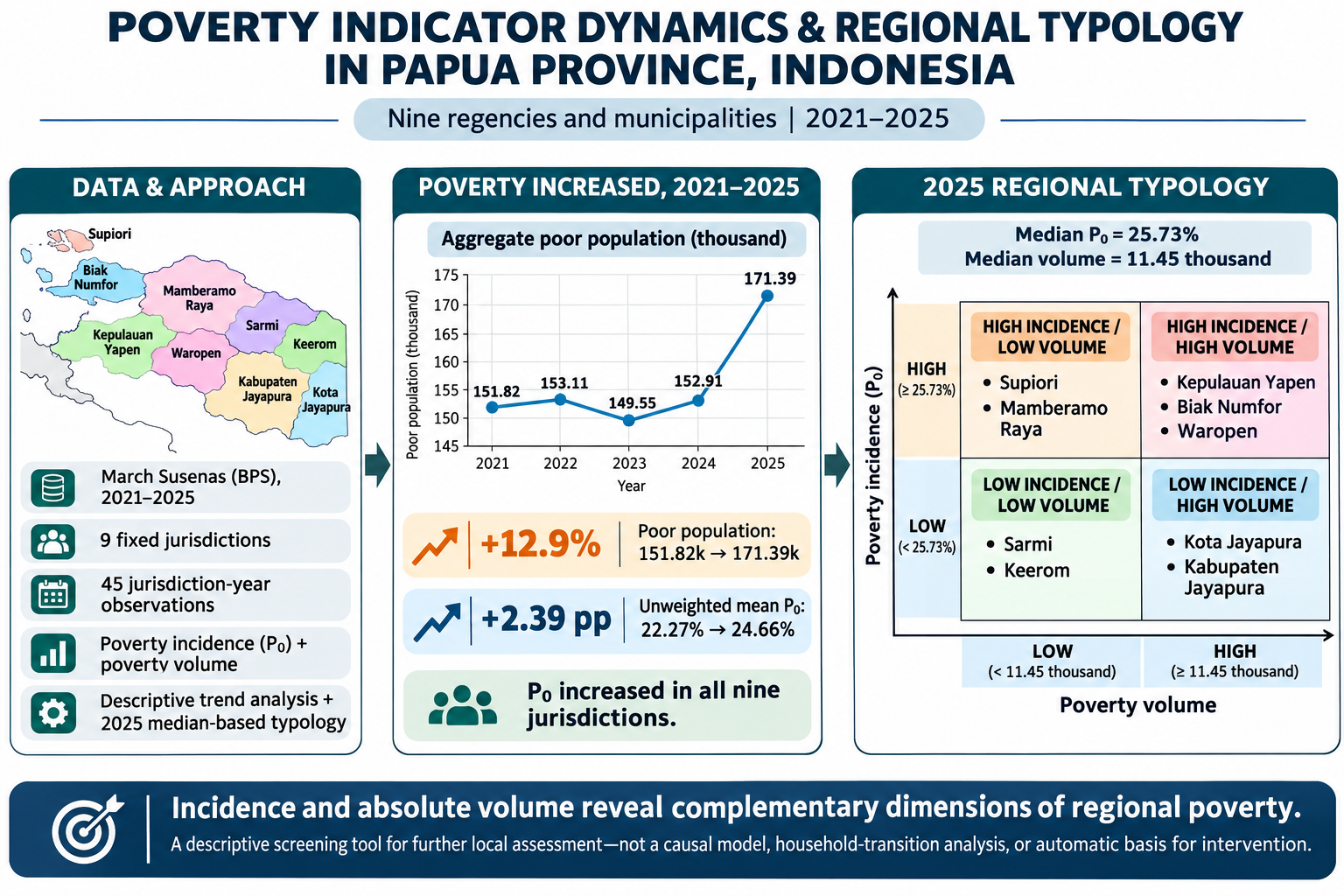
This study examines changes in poverty incidence and poverty volume across a consistent set of nine regencies and municipalities within the current administrative boundaries of Papua Province, Indonesia, during 2021–2025. In this article, poverty dynamics refers to changes in aggregate jurisdiction-level indicators, not household transitions into or out of poverty. Using secondary data from the March Susenas published by Statistics Indonesia (Badan Pusat Statistik, BPS), the study compares the reported number of poor residents and the official poverty headcount ratio (P0) and develops a median-based typology for 2025. The sum of the nine jurisdiction-level poverty counts increased from 151.82 thousand in 2021 to 171.39 thousand in 2025 (12.9%). The unweighted mean P0 increased from 22.27% to 24.66%, a rise of 2.39 percentage points, and P0 increased in all nine jurisdictions. The largest increases occurred in Mamberamo Raya (+6.31 percentage points) and Supiori (+4.65 percentage points). The 2025 typology uses the medians of P0 (25.73%) and poverty volume (11.45 thousand) as relative thresholds; values equal to or above each median are classified as high. The resulting profiles distinguish high-incidence/high-volume, high-incidence/low-volume, low-incidence/high-volume, and low-incidence/low-volume jurisdictions. The findings demonstrate the complementary value of incidence and absolute volume for regional comparison within the current administrative boundaries of Papua Province. The typology is a descriptive screening tool for identifying dimensions that require further local assessment; it does not establish causes or determine effective interventions.
Downloads
References
Anggraeni, R. M., Khusaini, M., & Prasetyia, F. (2022). Fiscal decentralization and its effect on poverty alleviation: A case study of Indonesia. Bulletin of Islamic Economics, 1(2), 35–48. https://doi.org/10.14421/bie.2022.012-04
Badan Pusat Statistik Provinsi Papua. (2021). Provinsi Papua dalam angka 2021. https://papua.bps.go.id/id/publication/2021/02/26/aae8d17cd6f20e61a590d990/provinsi-papua-dalam-angka-2021.html
Badan Pusat Statistik Provinsi Papua. (2022). Provinsi Papua dalam angka 2022. https://papua.bps.go.id/id/publication/2022/02/25/e3c19d14b0c4b1210b49aa96/provinsi-papua-dalam-angka-2022.html
Badan Pusat Statistik Provinsi Papua. (2023). Provinsi Papua dalam angka 2023. https://papua.bps.go.id/id/publication/2023/02/28/68b848a54207a64d0c42ddb6/provinsi-papua-dalam-angka-2023.html
Badan Pusat Statistik Provinsi Papua. (2024). Provinsi Papua dalam angka 2024. https://papua.bps.go.id/id/publication/2024/02/28/de1c58318d7d8ba84c8b3f56/provinsi-papua-dalam-angka-2024.html
Badan Pusat Statistik Provinsi Papua. (2025). Provinsi Papua dalam angka 2025. https://papua.bps.go.id/id/publication/2025/02/28/a6f1b1b106eed051e9bdc870/provinsi-papua-dalam-angka-2025.html
Croon, T. M., Hoekstra, J. S. C. M., Elsinga, M. G., Dalla Longa, F., & Mulder, P. (2023). Beyond headcount statistics: Exploring the utility of energy poverty gap indices in policy design. Energy Policy, 177, 113579. https://doi.org/10.1016/j.enpol.2023.113579
Difinubun, M. F., Tambunan, A. A., & Tabuni, L. (2025). Development of integrated transportation system to enhance inter-district connectivity in Jayawijaya Regency. Al-Kharaj: Journal of Islamic Economic and Business, 7(4). https://doi.org/10.24256/kharaj.v7i4.8055
Firdausy, C. M., & Budisetyowati, D. A. (2022). Variables, dimensions, and indicators important to develop the multidimensional poverty line measurement in Indonesia. Social Indicators Research, 162(2), 763–802. https://doi.org/10.1007/s11205-021-02859-5
Hardi, I., Kurniawan, R., Ray, S., Idroes, G. M., Noviandy, T. R., & Majid, M. S. A. (2025). Reducing the poverty gap and severity in Indonesia: The role of renewable energy access and consumption. Human Settlements and Sustainability, 1(3), 145–157. https://doi.org/10.1016/j.hssust.2025.06.001
Hill, H. (2021). What’s happened to poverty and inequality in Indonesia over half a century? Asian Development Review, 38(1), 68–97. https://doi.org/10.1162/adev_a_00158
Huda, A., Az-Zahra, A., Yasmin, F., Ningrum, I., Putra, W., & Budiasih, B. (2023). Spatial regression analysis of poverty percentage on Eastern Indonesia in 2022. Seminar Nasional Official Statistics, 2023(1), 747–756. https://doi.org/10.34123/semnasoffstat.v2023i1.1792
Indrasari, N., & Yulianto, S. (2025). Determinants of poverty in Papua Province: A panel data regression approach (2021–2023). Jurnal Statistika dan Aplikasinya, 9(1), 140–152. https://doi.org/10.21009/JSA.09112
Liang, Y., Li, S., Zeng, J., & Wu, T. (2022). Examining the impact of multidimensional accessibility on regional poverty in Laos. Applied Geography, 148, 102789. https://doi.org/10.1016/j.apgeog.2022.102789
Liu, Y., Liu, J., & Zhou, Y. (2017). Spatio-temporal patterns of rural poverty in China and targeted poverty alleviation strategies. Journal of Rural Studies, 52, 66–75. https://doi.org/10.1016/j.jrurstud.2017.04.002
Medeiros, V., Ribeiro, R. S. M., & Amaral, P. V. M. do. (2021). Infrastructure and household poverty in Brazil: A regional approach using multilevel models. World Development, 137, 105118. https://doi.org/10.1016/j.worlddev.2020.105118
Miranti, R. C., & Asdiyanti, S. J. (2026). Illuminating inequality: Heterogeneous effects of financial inclusion on urban-rural economic performance and economic resilience in Papua. Regional Science Policy & Practice, 18(4), 100288. https://doi.org/10.1016/j.rspp.2026.100288
Miranti, R. C., & Mendez, C. (2023). Social and economic convergence across districts in Indonesia: A spatial econometric approach. Bulletin of Indonesian Economic Studies, 59(3), 421–445. https://doi.org/10.1080/00074918.2022.2071415
Muryani, & Anggraini, A. (2025). The role of infrastructure on poverty in Papua Island of Indonesia. International Journal of Research in Social Science and Humanities, 6(6), 81–95. https://doi.org/10.47505/IJRSS.2025.6.6
Novianti, A., Afnan, I., Ilmi, R., & Widodo, E. (2021). Grouping of districts based on poverty factors in Papua Province uses the K-Medoids algorithm. Enthusiastic: International Journal of Applied Statistics and Data Science, 1, 94–102. https://doi.org/10.20885/enthusiastic.vol1.iss2.art6
Nugroho, Y., & Sujarwoto. (2021). Institutions, outputs and outcomes: Two decades of decentralization and state capacity in Indonesia. Journal of Southeast Asian Economies (JSEAE), 38(3), 296–319. https://muse.jhu.edu/article/845325
Oktaviani, D., Lestari, D., & Widyaningsih, Y. (2023). Analysis of factors affecting poverty in Papua Island using spatial panel data for 2017–2020. Global Scientific and Academic Research Journal of Multidisciplinary Studies, 2(12). https://gsarpublishers.com/abstract-669/
Pentury, M. A. (2023). The determinants of poverty in the West Papua province. Jurnal Ekonomi & Studi Pembangunan, 24(2), 285–296. https://doi.org/10.18196/jesp.v24i2.18428
Pulungan, M. A., Wardana, W. W., Haryanto, T., Afiatno, B. E., Rachmaningtyas, L., Hidayati, N. A., & Kusumawardani, D. (2026). Beyond household characteristics: A multilevel analysis of multidimensional poverty in East Java, Indonesia. Global Transitions. Advance online publication. https://doi.org/10.1016/j.glt.2026.09.001
Santoso, K. N., Abiyyi, F., & Marselino, A. R. K. (2022). Analisis spasial kemiskinan pada masa pemulihan pandemi Covid-19 di Jawa Barat tahun 2021. Jurnal Statistika dan Aplikasinya, 6(2), 288–299. https://doi.org/10.21009/JSA.06214
Siburian, M. E. (2022). The link between fiscal decentralization and poverty – Evidence from Indonesia. Journal of Asian Economics, 81, 101493. https://doi.org/10.1016/j.asieco.2022.101493
Sugiharti, L., Purwono, R., Esquivias, M. A., & Jayanti, A. D. (2022). Poverty dynamics in Indonesia: The prevalence and causes of chronic poverty. Journal of Population and Social Studies [JPSS], 30, 423–447. https://so03.tci-thaijo.org/index.php/jpss/article/view/258737
Susanto, D., & Wulandari, T. S. (2021). Multidimensional poverty: Identification of deprivation characteristics of Papua's population poverty in 2020. The Indonesian Journal of Planning and Development, 6(2), 56–66. https://doi.org/10.14710/ijpd.6.2.56-66
Sutjipto, H., Ginanjar, R. A. F., & Kustanto, A. (2026). Fiscal allocation and extreme poverty reduction: Patterns of regional targeting mismatch in Banten Province, Indonesia. Jurnal Perspektif Pembiayaan dan Pembangunan Daerah, 14(3), 290–310. https://doi.org/10.22437/ppd.v14i3.54050
Wahyuni, R. N. T., Ikhsan, M., Damayanti, A., & Khoirunurrofik, K. (2022). Inter-district road infrastructure and spatial inequality in rural Indonesia. Economies, 10(9), 229. https://doi.org/10.3390/economies10090229
Widita, A. A., Lechner, A. M., & Widyastuti, D. T. (2024). Spatial patterns and drivers of micro, small and medium-sized enterprises (MSMEs) within and across Indonesian cities: Evidence from highly granular data. Regional Science Policy & Practice, 16(11), 100137. https://doi.org/10.1016/j.rspp.2024.100137
World Bank. (2022). Indonesia economic prospects: Financial deepening for stronger growth and sustainable recovery. https://www.worldbank.org/en/country/indonesia/publication/indonesia-economic-prospects-iep-june-2022-financial-deepening-for-stronger-growth-and-sustainable-recovery
Zahra, Z. N., & Fernando, Z. (2026). Spatial spillover effects on poverty in Indonesia: Evidence from panel data analysis. Jurnal Dinamika Ekonomi Pembangunan, 9(1), 1–17. https://doi.org/10.14710/jdep.9.1.1-17
Downloads
Published
How to Cite
Issue
Section
License
Copyright (c) 2026 Marthinus Yohanes Ruamba

This work is licensed under a Creative Commons Attribution-NonCommercial 4.0 International License.