From formal regulation to local practice: Water governance and community vulnerability among forest-fringe communities in Sumedang, Indonesia
DOI:
https://doi.org/10.37905/drsj.v5i1.185Keywords:
Authority, Power, Protection, Water ManagementAbstract
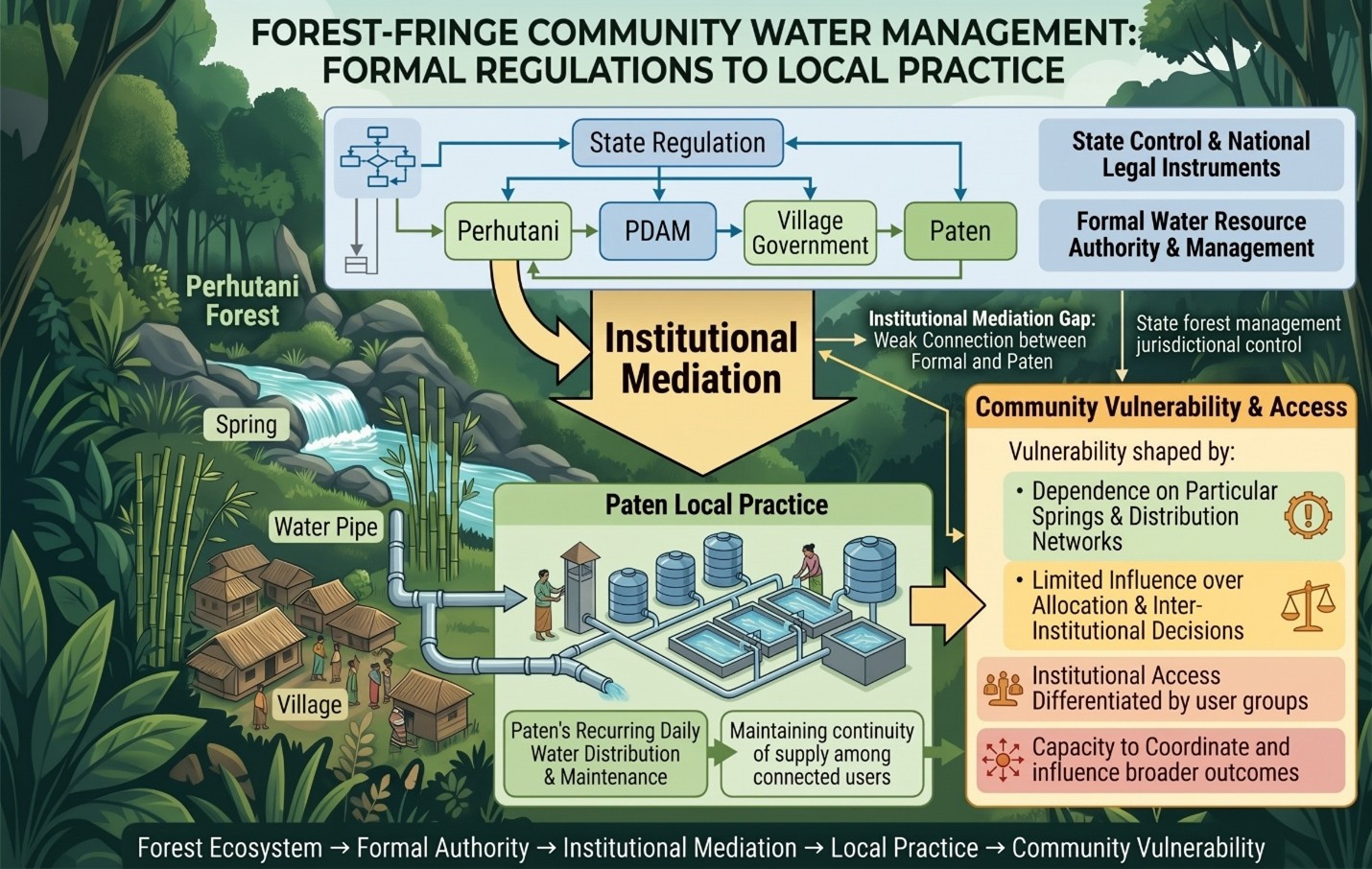
Water governance is particularly important in forest-fringe communities where households depend on spring water while access and management are mediated by multiple formal and community-based institutions. This study examines how formal regulatory authority over water resources is translated into local governance arrangements and shapes community access and vulnerability. A qualitative case study was conducted in Kadakajaya and Genteng Villages, Sumedang Regency, West Java, Indonesia, focusing on spring water sources located within or adjacent to forest areas managed by Perhutani, a state-owned forestry enterprise. The study integrates qualitative content analysis of national legal instruments within the 2014–2021 regulatory corpus with field research conducted from March to October 2024. Primary data were collected through field observations, semi-structured interviews with 15 purposively selected informants from the community and local institutions, and two focus group discussions involving community water-user groups, village officials, and local stakeholders. The focus group discussions also included participatory water-source mapping. The findings show that Indonesia’s regulatory framework establishes state responsibility for water-resource regulation and management while recognizing people’s rights to water for basic daily needs and providing a basis for community participation. Locally, however, formal authority is mediated through fragmented institutional arrangements involving Perhutani, village governments, the regional public water utility (PDAM), and community water-user groups. Community arrangements known as paten play an important role in everyday water distribution and infrastructure maintenance but have more limited influence over broader allocation and inter-institutional decisions. Vulnerability is shaped not only by dependence on particular springs and distribution systems but also by institutional access, coordination, and the capacity to influence decisions. From a structuration perspective, community agency sustains everyday water-governance practices within an uneven distribution of authoritative and allocative resources. The study identifies an institutional mediation gap between formal regulatory authority and local water-governance practices as a key governance challenge.
Downloads
References
Basuki, T. M., Nugroho, H. Y. S. H., Indrajaya, Y., Pramono, I. B., Nugroho, N. P., Supangat, A. B., Indrawati, D. R., Savitri, E., Wahyuningrum, N., Purwanto, Cahyono, S. A., Putra, P. B., Adi, R. N., Nugroho, A. W., Auliyani, D., Wuryanta, A., Riyanto, H. D., Harjadi, B., Yudilastyantoro, C., … Simarmata, D. P. (2022). Improvement of integrated watershed management in Indonesia for mitigation and adaptation to climate change: A review. Sustainability, 14(16), 9997. https://doi.org/10.3390/su14169997
Brown, D. L., & Shucksmith, M. (2017). Reconsidering territorial governance to account for enhanced rural-urban interdependence in America. The ANNALS of the American Academy of Political and Social Science, 672(1), 282–301. https://doi.org/10.1177/0002716217706495
Carvalho, P., & Spataru, C. (2023). Overcoming resource nexus conflicts with a normative-institutional approach: A case study of Brazil. Frontiers in Water, 3. https://doi.org/10.3389/frwa.2021.747208
Cutter, S. L., Boruff, B. J., & Shirley, W. L. (2003). Social vulnerability to environmental hazards. Social Science Quarterly, 84(2), 242–261. https://doi.org/10.1111/1540-6237.8402002
du Plessis, A. (2023). Water resources from a global perspective. In South Africa’s water predicament (pp. 1–25). Springer. https://doi.org/10.1007/978-3-031-24019-5_1
Ford, J. D., Pearce, T., McDowell, G., Berrang-Ford, L., Sayles, J. S., & Belfer, E. (2018). Vulnerability and its discontents: the past, present, and future of climate change vulnerability research. Climatic Change, 151(2), 189–203. https://doi.org/10.1007/s10584-018-2304-1
Giddens, A. (2010). Teori strukturasi: Dasar-dasar pembentukan struktur sosial masyarakat. Pustaka Pelajar.
Giddens, A. (2014). Structuration theory: past, present and future. In Giddens’ theory of structuration (pp. 201–221). Routledge.
Goldschmeding, F., Kemp, R., Vasseur, V., & Scholl, C. (2025). Institutional logics as an object of change: the experiences of a water organization using design thinking for climate adaptation in a multi-stakeholder process. Sustainability Science, 20(3), 759–776. https://doi.org/10.1007/s11625-025-01660-4
Görmar, F., Grillitsch, M., Hruška, V., Mihály, M., Nagy, E., Píša, J., & Stihl, L. (2023). Power relations and local agency: a comparative study of European mining towns. Urban Research & Practice, 16(4), 558–581. https://doi.org/10.1080/17535069.2022.2051066
Hargono, A., Waloejo, C., Pandin, M. P., & Choirunnisa, Z. (2022). Penyuluhan pengolahan sanitasi air bersih untuk meningkatkan kesehatan masyarakat Desa Mengare, Gresik. Abimanyu: Journal of Community Engagement, 3(1), 1–10. https://doi.org/10.26740/abi.v3n1.p1-10
Higgs, C. J., Hill, T. R., & Meissner, R. (2025). Equity in water resource management: A theoretical dynamism. Natural Resources Forum, 49(3), 2736–2752. https://doi.org/10.1111/1477-8947.12501
Kirby, M., & Mainuddin, M. (2022). The impact of climate change, population growth and development on sustainable water security in Bangladesh to 2100. Scientific Reports, 12(1), 22344. https://doi.org/10.1038/s41598-022-26807-6
Lema, M. W. (2025). Sustaining rural livelihoods through participatory water governance: A review of community-driven water resource management models in East and Central Africa. Frontiers in Water, 7. https://doi.org/10.3389/frwa.2025.1704600
McKee, E. (2025). Procedural justice in water management: A review. Water, 17(13), 1987. https://doi.org/10.3390/w17131987
Pambudi, A. S., & Kusumanto, T. (2023). Water resources governance in Indonesia towards environmental sustainability along with social and economic development. In A. Triyanti, M. Indrawan, L. Nurhidayah, & M. A. Marfai (Eds.), Environmental governance in Indonesia (Environment & Policy, Vol. 61, pp. 289–311). Springer. https://doi.org/10.1007/978-3-031-15904-6_16
Phelia, A., & Cambodia, M. (2025). Integrated water resources management in the Seputih Sekampung River Basin, Indonesia: Challenges strategies and institutional synergy. Journal of Engineering Innovation and Management Science, 1(1), 50–62. https://doi.org/10.64780/jeims.v1i1.5
Rizaldy, W. F. (2023). Paradigma dan pengaturan pengelolaan sumber daya air pasca lahirnya Undang-Undang Nomor 17 Tahun 2019. Journal of Law and Administrative Science, 1(2), 51–62. https://doi.org/10.33478/jlas.v1i2.13
Rossi, F. (2022). Method and practice for integrated water landscapes management: River contracts for resilient territories and communities facing climate change. Urban Science, 6(4), 83. https://doi.org/10.3390/urbansci6040083
Rosso, R. (2025). On seven principles of water governance. Water, 17(6), 896. https://doi.org/10.3390/w17060896
Salman Khan, M., & Syrett, S. (2022). An institutional analysis of ‘power within’ local governance: A Bazaari tale from Pakistan. World Development, 154, 105882. https://doi.org/10.1016/j.worlddev.2022.105882
Samsu, A., Holzhacker, R. L., Woltjer, J., Maryati, S., & Suhartini, N. (2025). Understanding informal mechanisms in integrated urban water management (IUWM): Evidence from Makassar, Indonesia. Habitat International, 163, 103459. https://doi.org/10.1016/j.habitatint.2025.103459
Simanihuruk, M., Sitorus, H., Ismail, R., Sitanggang, T., & Sihotang, D. (2025). Community resilience and adaptive strategies for clean water scarcity in Salaon Toba Village, Lake Toba, Indonesia. Sustainability, 17(22), 10335. https://doi.org/10.3390/su172210335
Whittington, R. (2010). Giddens, structuration theory and strategy as practice. In D. Golsorkhi, L. Rouleau, D. Seidl, & E. Vaara (Eds.), Cambridge handbook of strategy as practice (pp. 109–126). Cambridge University Press.
Wulandari, A. S. R., & Ilyas, A. (2019). Pengelolaan sumber daya air di Indonesia: Tata pengurusan air dalam bingkai otonomi daerah. Gema Keadilan, 6(3), 287–299. https://doi.org/10.14710/gk.2019.6750
Yunita, D., Nurwati, N., Gunawan, W., & Azman, A. (2024). Social practices in water use drive vulnerability in forest edge village communities in Sumedang Regency. Sosiohumaniora, 26(1), 106–116. https://doi.org/10.24198/sosiohumaniora.v26i1.50982
Yunita, D., Nurwati, R. N., & Gunawan, W. (2022). Lokakarya penguatan kapasitas lembaga pengelola air sebagai upaya pemanfaatan air berkelanjutan. Kumawula: Jurnal Pengabdian Kepada Masyarakat, 5(3), 494. https://doi.org/10.24198/kumawula.v5i3.38533
Downloads
Published
How to Cite
Issue
Section
License
Copyright (c) 2026 Desi Yunita, Nunung Nurwati, Wahyu Gunawan, Aditya Candra Lesmana, Elsa Lutmilarita Amanatin, Ardi Maulana Nugraha

This work is licensed under a Creative Commons Attribution-NonCommercial 4.0 International License.



.png)