Salbia-based ethical resilience and village bureaucratic neutrality: Evidence from the 2024 regional head election in Bone Bolango, Indonesia
DOI:
https://doi.org/10.37905/drsj.v5i1.191Keywords:
Bureaucratic Neutrality, Conditional Obedience, Electoral Supervision, Salbia, Village GovernmentAbstract
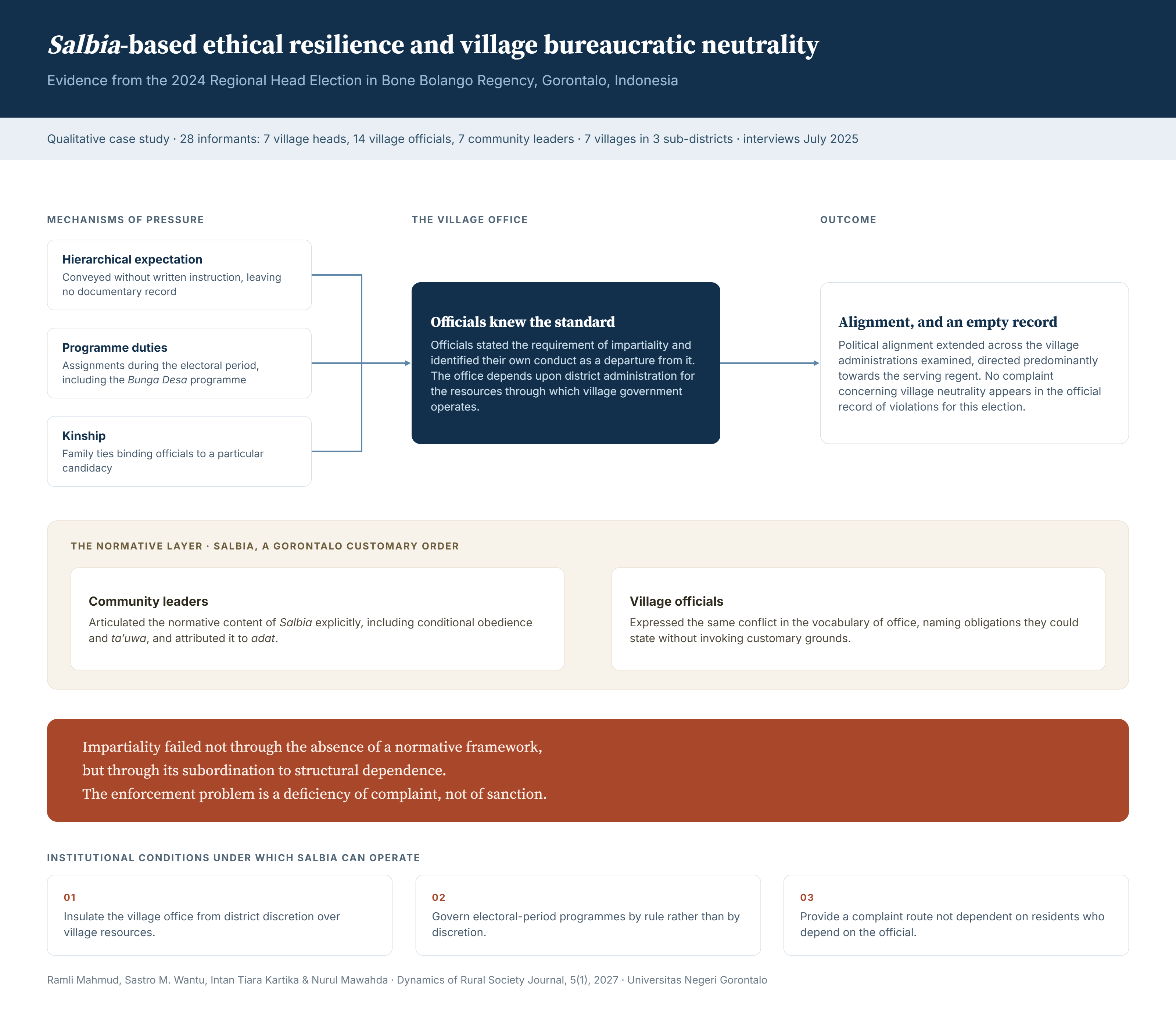
Village officials occupy a position of unusual electoral value in rural democracies, yet the conditions under which they sustain or abandon administrative impartiality remain inadequately specified. This article examines how village officials in Bone Bolango Regency, Indonesia, responded to political demands during the 2024 Regional Head Election, and assesses the operation and limits of Salbia, a Gorontalo customary order, as an analytical framework for impartial administrative conduct. The study employs a qualitative case study design. Twenty-eight informants, comprising seven village heads, fourteen village officials, and seven community leaders from seven villages in three subdistricts, were interviewed in July 2025, and the material was analyzed thematically alongside observational and documentary sources. Political alignment extended across the village administrations examined and was directed predominantly toward the candidacy of the serving regent. It was produced by hierarchical expectation transmitted without written instruction, by duties allocated during the electoral period, including the Bunga Desa program, and by kinship ties. Officials identified their own conduct as a departure from obligations they were able to state. The normative content of Salbia, including conditional obedience and ta’uwa, was articulated explicitly by community leaders and attributed to adat, whereas officials expressed the same conflict in the vocabulary of office without invoking customary grounds. The article argues that impartiality failed not through the absence of a normative framework but through its subordination to structural dependence, and that the enforcement problem is more accurately described as a deficiency of complaint than as a deficiency of sanction. Salbia is accordingly proposed with its institutional conditions specified, namely insulation of the village office from district discretion, rule-bound governance of programs during electoral periods, and a complaint procedure not dependent upon residents who themselves depend upon the official concerned.
Downloads
References
Abdi, A. (2026). Local political competition and bureaucratic ethics: An analysis of the local government integrity index in South Sulawesi. Journal of Contemporary Local Politics, 5(1), 137–149. https://doi.org/10.46507/jclp.v5i1.761
Angkasa, N., & Pelangi, I. (2024). Implementation of village heads’ neutralism in the general election campaign based on Law Number 6 of 2014 concerning Villages. Muhammadiyah Law Review, 8(1), 42–48. https://doi.org/10.24127/mlr.v8i1.3178
Antlöv, H. (2003). Village government and rural development in Indonesia: The new democratic framework. Bulletin of Indonesian Economic Studies, 39(2), 193–214. https://doi.org/10.1080/00074910302013
Aspinall, E., & As’ad, M. U. (2015). The patronage patchwork: Village brokerage networks and the power of the state in an Indonesian election. Bijdragen tot de Taal-, Land- en Volkenkunde, 171(2–3), 165–195. https://doi.org/10.1163/22134379-17102004
Aspinall, E., & Berenschot, W. (2019). Democracy for Sale: Elections, Clientelism, and the State in Indonesia. Cornell University Press. http://www.jstor.org/stable/10.7591/j.ctvdtphhq
Atmojo, M. E., Sulaksono, T., Hanif, N. A., & Fridayani, H. D. (2023). The problem of neutrality of the State Civil Apparatus (ASN) in the 2020 regional head election. Jurnal Aristo (Social, Politic, Humaniora), 11(2), 220–237. https://doi.org/10.24269/ars.v11i2.6101
Babbie, E. R. (2021). The practice of social research. Cengage Learning. https://www.cengage.com/c/the-practice-of-social-research-15e-babbie/9780357360767
Badan Pengawas Pemilihan Umum Republik Indonesia. (2024). Surat Edaran Nomor 92 Tahun 2024 tentang Penanganan Pelanggaran Netralitas Kepala Desa pada Pemilihan Kepala Daerah Serentak Tahun 2024.
Bela, B. A., & Rahmawati, D. E. (2026). The neutrality of village officials in the 2024 simultaneous regional elections in Bantul Regency. Jurnal Aristo (Social, Politic, Humaniora), 14(2), 1195–1210. https://doi.org/10.24269/ars.v14i2.12716
Bertelli, A. M., & Falletti, V. (2026). Bureaucracy under pressure: Structural integrity and the ethics of democratic administration. International Review of Administrative Sciences, 92(3), 350-368. https://doi.org/10.1177/00208523251406200
Cingolani, L., Lotta, G., Silveira, M. C., Gomide, A. A., Masson, P., Miranda, P. dos S., & Guedes-Neto, J. (2026). The agency of (public) agencies: How perceived organizational protections shape civil servants’ resistance to democratic backsliding. International Review of Administrative Sciences. Advance online publication. https://doi.org/10.1177/00208523261440169
Dahlström, C., & Lapuente, V. (2022). Comparative bureaucratic politics. Annual Review of Political Science, 25, 43–63. https://doi.org/10.1146/annurev-polisci-051120-102543
Ganesha, G., Adnyani, N. K. S., Fajar, N. M. A. P., & Dantes, K. F. (2026). Utilitarian analysis of the enforcement of village head neutrality. Awang Long Law Review, 8(4), 984–990. https://doi.org/10.56301/awl.v8i4.2173
González, C. I., & Sanabria-Pulido, P. (2026). When politics shapes administration: Bureaucratic autonomy, policy role separation, and organizational capacity in an institutionally weak public administration. Public Administration and Development. Advance online publication. https://doi.org/10.1002/pad.70050
Guan, Y. (2018). Demand for democracy in resilient authoritarianism: Evidence from rural China. Democratization, 25(7), 1073–1092. https://doi.org/10.1080/13510347.2018.1445086
Gusniar, A., Maryanah, T., & Kurniawan, R. C. (2026). Strategies for preventing vote buying and enforcing village apparatus neutrality in the 2024 elections. Journal of Social Politics and Governance, 8(1), 209–226. https://doi.org/10.24076/bqh1vw61
Haga, B. J. (1981). Lima Pahalaa: Susunan masyarakat, hukum adat dan kebijaksanaan pemerintahan di Gorontalo. Djambatan.
Hartono, C., & Wijaya, A. (2025). Tinjauan yuridis terhadap siri’ dan pesse sebagai asas moral dalam penyelesaian sengketa waris adat Bugis. Jurnal Ilmu Hukum, Humaniora dan Politik, 6(2), 1101–1110. https://doi.org/10.38035/jihhp.v6i2.6774
Husain, M. N., & Nasir, M. (2021). Bureaucracy involvement in local election in Konawe Selatan District. Indonesian Journal of Innovation and Applied Sciences, 1(1), 52–58. https://doi.org/10.47540/ijias.v1i1.157
Indiahono, D. (2022). Bureaucratic neutrality index in direct regional head elections: Optimism in developing professional bureaucracy in Indonesia. Public Policy and Administration, 21(3), 249–261. https://doi.org/10.5755/j01.ppaa.21.3.31788
Jaraíz-Arroyo, G., Ruiz-Ballesteros, E., and García, M. (2025). Eco-esteem and depopulation: Broadening the perspective on the demographic challenge in the rural world. Rural Sociology, 90(1), 46–63. https://doi.org/10.1111/ruso.12575
Johnson, C. (2001). Local democracy, democratic decentralisation and rural development: Theories, challenges and options for policy. Development Policy Review, 19(4), 521–532. https://doi.org/10.1111/1467-7679.00149
Keputusan Komisi Pemilihan Umum Kabupaten Bone Bolango Nomor 1545 Tahun 2024 tentang Penetapan Hasil Pemilihan Bupati dan Wakil Bupati Bone Bolango Tahun 2024. https://jdih.kpu.go.id/kepkpukabkot/download_abstrak/118115
Kucinskas, J. L., & Silveira, M. C. (2026). Acts of moral courage among civil servants under democratic backsliding: A comparison of the Trump and Bolsonaro administrations. International Review of Administrative Sciences. Advance online publication. https://doi.org/10.1177/00208523261477053
Lee, D. S., & Park, S. (2021). Bureaucratic responsiveness in times of political crisis: The case of presidential impeachment. Public Administration, 99(3), 563–580. https://doi.org/10.1111/padm.12701
Lewis, D., & Hossain, A. (2022). Local political consolidation in Bangladesh: Power, informality and patronage. Development and Change, 53(2), 356–375. https://doi.org/10.1111/dech.12534
Mahmud, R., Adjie, Z., Wantu, A., & Yunus, R. (2024). Penguatan perilaku rasional politik birokrasi (ASN, kepala desa beserta perangkat desa) di Kecamatan Kabila dan Kecamatan Bulango Timur. Journal of Human and Education, 4(5), 1159–1164. https://garuda.kemdiktisaintek.go.id/documents/detail/4640869
Mahmud, R., Djaafar, L., Wantu, S. M., & Adjie, Z. (2024). Netralitas birokrasi (ASN, kepala desa beserta perangkat desa) di Kecamatan Botupingge dan Kecamatan Suwawa Selatan. Journal of Human and Education, 4(5), 1144–1151. https://jahe.or.id/index.php/jahe/article/view/1707
Mahmud, R., Yunus, R., & Adjie, Z. (2022). Alternative in strengthening bureaucratic neutrality through political culture in the 2019 election in Boalemo Regency. Inovasi: Politik dan Kebijakan, 19(2), 187–199. https://doi.org/10.33626/inovasi.v19i2.597
Marvasti, A. B. (2004). Qualitative research in sociology. SAGE Publications. https://us.sagepub.com/en-us/sam/qualitative-research-in-sociology/book224943
Maulana, M. A., Nurfaisal, M. D., & Al-Ra’zie, Z. H. (2025). Restoring integrity: Re-voting of the 2025 Serang Regent election and its transformative power for local democracy. Journal of Contemporary Local Politics, 4(1), 81–91. https://doi.org/10.46507/jclp.v4i1.708
Mumtaz, E., Fatimah, B. W. N., Al Farisi, Y., Sari, T., Laksintya, A. C., & Budiono, A. (2026). Legal analysis of civil servant neutrality in general elections. Journal of Human Interaction and Social Studies, 1(2), 97–105. https://doi.org/10.65310/735fy090
Nadzirin, A., Sukmariningsih, R. M., & Mashari, M. (2025). Does the State Civil Apparatus violate neutrality during elections? Journal of Sustainable Development and Regulatory Issues, 3(2), 400–433. https://doi.org/10.53955/jsderi.v3i2.112
Neuman, W. L. (2014). Social research methods: Qualitative and quantitative approaches. Pearson. https://www.pearson.com/en-gb/subject-catalog/p/social-research-methods-pearson-new-international-edition/P200000005113/9781292033617
Park, C.-O., & Han, S. (2018). Bureaucratic responses to the cross pressures of political neutrality in relation to cultural orientation and role perception: The case of Korean civil servants. The Korean Journal of Policy Studies, 33(3), 47–71. https://doi.org/10.52372/kjps33303
Raiu, C. (2026). Cutting too close to the bone? Fragilizing the democratic resilience of public administration. International Review of Administrative Sciences. Advance online publication. https://doi.org/10.1177/00208523261478274
Renaldi, I., Halawa, H. S., Wahyuni, N., & Fajri, H. (2025). Empowering public administrators: Ethics and public service values. Journal of Public Affairs Education. Advance online publication. https://doi.org/10.1080/15236803.2025.2500688
Rifai, R., & Haeril, H. (2024). Dilema etis dan imparsialitas birokrasi pada Pilkada serentak Kota Bima 2024. Journal of Governance and Local Politics, 6(2), 293–303. https://doi.org/10.47650/jglp.v6i2.1554
Rizal, A. N., Al-Zahra, K. K., & Agustina, A. V. A. (2025). Implementasi penanganan pelanggaran netralitas Aparatur Sipil Negara pada Pemilihan Kepala Daerah 2024 di Kabupaten Mojokerto. Jurnal Administrasi Pemerintahan Desa, 6(2), 1–13. https://doi.org/10.47134/villages.v6i2.259
Ryu, S., & Virindra, N. (2023). Impaired neutrality: A propensity that occurs among Indonesian bureaucrats in the election. Policy & Governance Review, 7(1), 38–53. https://doi.org/10.30589/pgr.v7i1.622
Saragih, A. Y., & Ivanna, J. (2024). Politik kekerabatan dalam pemilihan kepala desa di Desa Dolog Huluan Kabupaten Simalungun. Journal on Education, 6(4), 20619–20626. https://doi.org/10.31004/joe.v6i4.6114
Sekpe, S. S., Upav, F. S., & Joseph, O. I. (2025). Political parties and electoral administration in Nigeria and Ghana: Exploring the nexus, 2015–2024. Journal of Contemporary Social Research, 9(1), 14–42. https://doi.org/10.5281/zenodo.19946057
Silveira, M. C., Lotta, G., Cingolani, L., Guedes-Neto, J., Gomide, A., & Souza, P. (2026). The organizational dynamics of bureaucratic resistance to undemocratic pressures: A conjoint experiment in Brazil. Public Administration Review. Advance online publication. https://doi.org/10.1111/puar.70097
Siswandani, D., & Prasetyo, K. B. (2022). Kuasa jejaring kerabat dalam praktik politik lokal pedesaan (kajian antropologi politik). Umbara, 7(1), 50–60. https://doi.org/10.24198/umbara.v7i2.39131
Sofyandi F., A. G., Erawan, I K. P., & Bandiyah. (2019). Rekonstruksi nilai siri’ na pacce dalam pembentukan dinasti politik Yasin Limpo. Politika Udayana, 1(2). https://ojs.unud.ac.id/index.php/politika/article/view/56470
Staronova, K., & Knox, C. (2024). Politicisation of the civil service: Contestation and context. NISPAcee Journal of Public Administration and Policy, 17(2), 215–237. https://doi.org/10.2478/nispa-2024-0019
Stauffer, B., Sager, F., & Kuenzler, J. (2024). Public agency resilience in times of democratic backsliding: Structure, collaboration and professional standards. Governance, 37(1), 21–40. https://doi.org/10.1111/gove.12802
Suswanta, S., & Setiawan, A. (2023). Regulatory ambiguity and its implications for the neutrality of the State Civil Apparatus in the vortex of practical politics. Cosmogov: Jurnal Ilmu Pemerintahan, 9(1). https://doi.org/10.24198/cosmogov.v9i1.45371
Toral, G. (2024). How patronage delivers: Political appointments, bureaucratic accountability, and service delivery in Brazil. American Journal of Political Science, 68(2), 797–815. https://doi.org/10.1111/ajps.12758
Zafarullah, H., & Kaiser, Z. R. M. A. (2025). Beyond Weber: The Bangladesh bureaucracy and the limits of theoretical models. Asian Journal of Comparative Politics. Advance online publication. https://doi.org/10.1177/20578911251363717
Downloads
Published
How to Cite
Issue
Section
License
Copyright (c) 2026 Ramli Mahmud, Sastro M. Wantu, Intan Tiara Kartika, Nurul Mawahda

This work is licensed under a Creative Commons Attribution-NonCommercial 4.0 International License.