Political–structural poverty in the arena of village democracy: Poverty profiles and unequal political participation in West Java
DOI:
https://doi.org/10.37905/drsj.v5i1.193Keywords:
Electoral Participation, Multidimensional Poverty, Transactional Politics, Village Democracy, Village DevelopmentAbstract
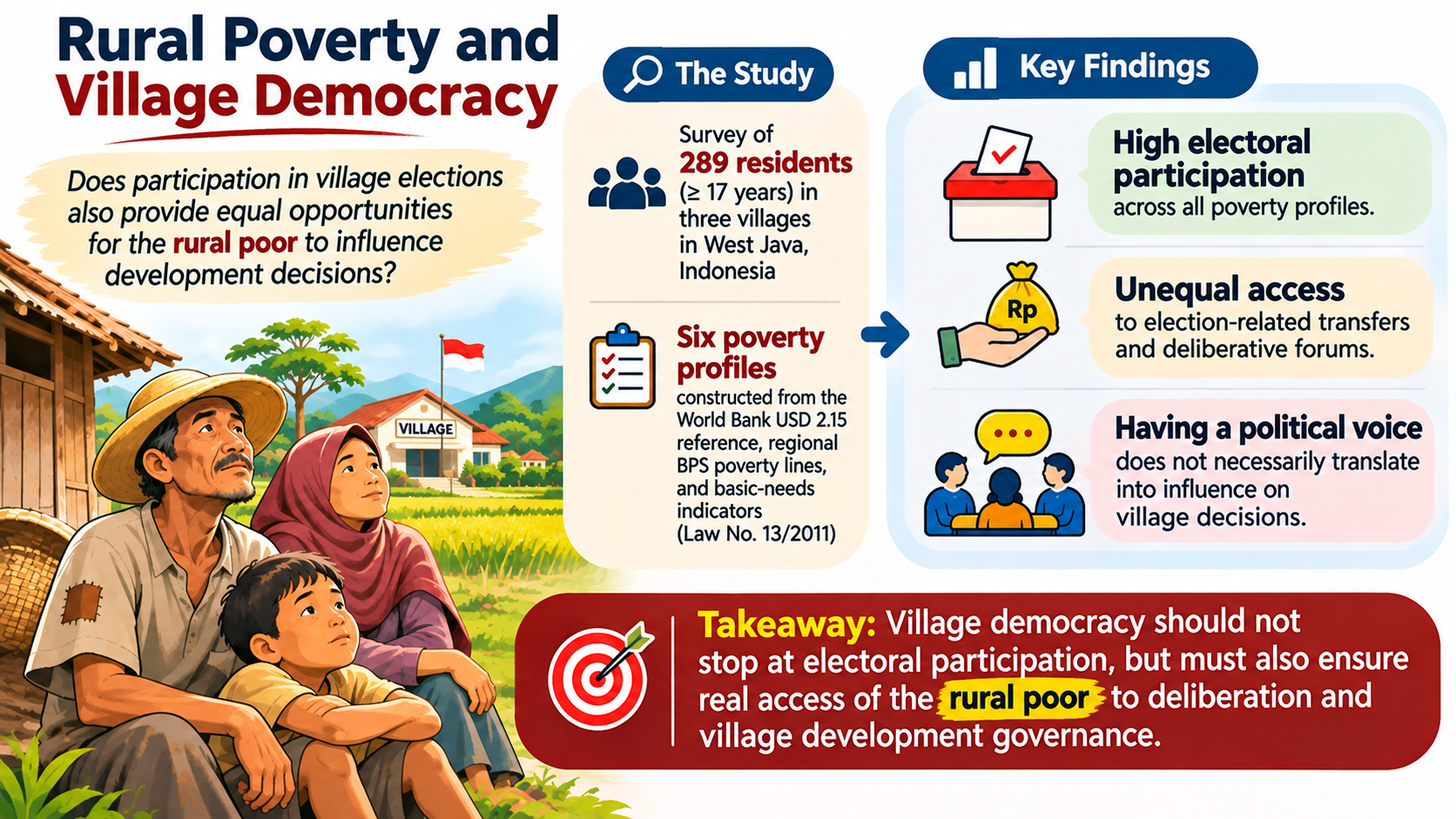
Rural poverty is not solely a condition of economic deprivation; it can also intersect with unequal access to political participation, public deliberation, and village development governance. Grounded in political sociology, this study examines how poverty profiles relate to electoral participation, election-related material transfers, perceived political voice and involvement in village planning in three West Java villages. A cross-sectional survey covered 289 residents aged 17 years or older. The study constructed six exploratory poverty profiles by cross-classifying a researcher-defined nominal monetary threshold derived from the World Bank (WB) USD 2.15 reference, regional BPS poverty lines, and selected basic-needs indicators informed by Undang-Undang Nomor 13 Tahun 2011 tentang Penanganan Fakir Miskin (Law No. 13 of 2011 on the Handling of the Poor). Descriptive tabulations indicate high reported electoral participation across the six poverty profiles, accompanied by more differentiated patterns of material receipt and participation in deliberative and planning arenas. This contrast suggests that formal electoral inclusion should not be equated with equal opportunities to participate substantively in village governance. However, reported transfers do not establish vote buying, and perceived political voice does not demonstrate influence on decisions. Three poverty subgroups were very small (n = 4, 8, and 13). The WB-derived monetary threshold was obtained through nominal exchange-rate conversion rather than a PPP-based calculation and is therefore treated as a study-defined analytical reference, not an official World Bank poverty line. The study highlights why the analysis of village democracy needs to connect electoral participation with access to deliberative and development institutions.
Downloads
References
Alfian, Mely G. Tan, & Selo Soemardjan. (1980). Social conditions. Yayasan Ilmu-Ilmu Sosial bekerja sama dengan Pulsar.
Asenbaum, H., Curato, N., Ibhawoh, B., Fuji Johnson, G., McCaul, J., & Mendonça, R. F. (2024). Can deliberative democracy be decolonized? A debate (Working Paper No. 2024/01). Centre for Deliberative Democracy and Global Governance, University of Canberra.
Aspinall, E., & Hicken, A. (2020). Guns for hire and enduring machines: Clientelism beyond parties in Indonesia and the Philippines. Democratization, 27(1), 137–156. https://doi.org/10.1080/13510347.2019.1590816
Aspinall, E., & Rohman, N. (2017). Village head elections in Java: Money politics and brokerage in the remaking of Indonesia’s rural elite. Journal of Southeast Asian Studies, 48(1), 31–52. https://doi.org/10.1017/S0022463416000461
Berenschot, W. (2021, November 11). The informality trap: Democracy against governance in Asia [Inaugural speech]. University of Amsterdam. https://dare.uva.nl/id/28dc813b-217f-4f9b-a5bb-9d0e85dd0863
Berenschot, W., & van Klinken, G. (2018). Informality and citizenship: The everyday state in Indonesia. Citizenship Studies, 22(2), 95–111. https://doi.org/10.1080/13621025.2018.1445494
Boese, V. A. (2019). How (not) to measure democracy. International Area Studies Review, 22(2), 95–127. https://doi.org/10.1177/2233865918815571
BPS-Statistics Indonesia. (2023). Profile of poverty in Indonesia, March 2023. https://www.bps.go.id/id/pressrelease/2023/07/17/2016/profil-kemiskinan-di-indonesia-maret-2023.html
BPS-Statistics Indonesia. (2024). Poverty line by regency/municipality, 2022–2024.
BPS-Statistics of Jawa Barat Province. (2022). Gini ratio of Jawa Barat Province. https://jabar.bps.go.id/indicator/23/68/1/gini-rasio-provinsi-jawa-barat.html
BPS-Statistics of Jawa Barat Province. (2023). Number of poor people (thousand persons) in Jawa Barat Province, 2021–2023. https://jabar.bps.go.id/indicator/23/83/1/jumlah-penduduk-miskin.html
Brady, D., & Burton, L. M. (Eds.). (2016). The Oxford handbook of the social science of poverty. Oxford University Press.
Bühlmann, M., Merkel, W., Müller, L., & Weßels, B. (2012). The Democracy Barometer: A new instrument to measure the quality of democracy and its potential for comparative research. European Political Science, 11(4), 519–536. https://doi.org/10.1057/eps.2011.46
D’Attoma, I., & Matteucci, M. (2024). Multidimensional poverty: An analysis of definitions, measurement tools, applications and their evolution over time through a systematic review of the literature up to 2019. Quality & Quantity, 58(4), 3171–3213. https://doi.org/10.1007/s11135-023-01792-8
Evans, M., Nogales, R., & Robson, M. (2024). Monetary and multidimensional poverty: Correlation, mismatches, and a combined approach. The Journal of Development Studies, 60(1), 147–170. https://doi.org/10.1080/00220388.2023.2252140
Ferejohn, J. A. (1974). Pork barrel politics: Rivers and harbors legislation, 1947–1968. Stanford University Press.
Fuchs, D., & Roller, E. (2018). Conceptualizing and measuring the quality of democracy: The citizens’ perspective. Politics and Governance, 6(1), 22–32. https://doi.org/10.17645/pag.v6i1.1188
Gassmann, F., Martorano, B., & Waidler, J. (2022). How social assistance affects subjective wellbeing: Lessons from Kyrgyzstan. The Journal of Development Studies, 58(4), 827–847. https://doi.org/10.1080/00220388.2021.1988079
Gonzalez-Ocantos, E., de Jonge, C. K., Meléndez, C., Osorio, J., & Nickerson, D. W. (2012). Vote buying and social desirability bias: Experimental evidence from Nicaragua. American Journal of Political Science, 56(1), 202–217. https://doi.org/10.1111/j.1540-5907.2011.00540.x
Granö, S. (2024). Divided we abstain: Testing the effect of local income inequality on individual-level turnout using Norwegian administrative panel data. Electoral Studies, 92, Article 102852. https://doi.org/10.1016/j.electstud.2024.102852
Hakim, L., Kolopaking, L. M., Sjaf, S., & Kinseng, R. A. (2025a). Assessing village democracy and welfare in rural Indonesia: An index-based correlation analysis. Frontiers in Political Science, 7, Article 1622507. https://doi.org/10.3389/fpos.2025.1622507
Hakim, L., Kolopaking, L. M., Sjaf, S., & Kinseng, R. A. (2025b). Understanding poverty and social assistance distribution: A multidimensional approach to rural poverty in Indonesia. AGRARIS: Journal of Agribusiness and Rural Development Research, 11(2), 255–275. https://doi.org/10.18196/agraris.v11i2.725
Hancock, G. (2005). Dewa-dewa pencipta kemiskinan: Kekuasaan, prestise, dan korupsi bisnis bantuan internasional (Y. Suprapto, Trans.). Cindelaras Pustaka Rakyat Cerdas.
Haryanto, Berenschot, W., & Aspinall, E. (2025). Participation without accountability: Deliberative democracy in village Indonesia. South East Asia Research, 33(1), 49–67. https://doi.org/10.1080/0967828X.2025.2483162
Hicken, A., Aspinall, E., Weiss, M. L., & Muhtadi, B. (2022). Buying brokers: Electoral handouts beyond clientelism in a weak-party state. World Politics, 74(1), 77–120. https://doi.org/10.1017/S0043887121000216
Huraerah, A. (2013). Strategi kebijakan penanggulangan kemiskinan di Indonesia. Jurnal Ilmu Kesejahteraan Sosial, 12(1), 3–13.
Iqbal, M., & Marto, H. (2022). Edukasi pengelolaan keuangan keluarga penerima manfaat Program Keluarga Harapan di Kelurahan Nalu Kecamatan Baolan Kabupaten Tolitoli. Dikmas: Jurnal Pendidikan Masyarakat dan Pengabdian, 2(3), 743–750. https://doi.org/10.37905/dikmas.2.3.743-750.2022
Jara, H. X., & Palacio Ludeña, M. G. (2024). Rethinking social assistance amid the COVID-19 pandemic: Guaranteeing the right to income security in Ecuador. Journal of International Development, 36(3), 1738–1764. https://doi.org/10.1002/jid.3878
Kurer, O. (1993). Clientelism, corruption, and the allocation of resources. Public Choice, 77(2), 259–273. https://doi.org/10.1007/BF01047869
Lewis, O. (2016). Kisah lima keluarga: Telaah-telaah kasus orang Meksiko dalam kebudayaan kemiskinan (R. Hamzah, Trans.; Ed. ke-2). Yayasan Pustaka Obor Indonesia.
McClelland, D. C., Atkinson, J. W., Clark, R. A., & Lowell, E. L. (1953). The achievement motive. Appleton-Century-Crofts. https://doi.org/10.1037/11144-000
Michener, J. (2018). Fragmented democracy: Medicaid, federalism, and unequal politics. Cambridge University Press. https://doi.org/10.1017/9781108224987
Pradhanawati, A., Tawakkal, G. T. I., & Garner, A. D. (2019). Voting their conscience: Poverty, education, social pressure and vote buying in Indonesia. Journal of East Asian Studies, 19(1), 19–38. https://doi.org/10.1017/jea.2018.27
Rahmanto, F., Firmansyah, M. I., Purwaningsih, T., & Rafi, M. (2021). Politik anggaran: Alokasi dana bansos pra-pemilihan presiden 2019 di Indonesia sebagai alat meningkatkan elektabilitas. Jurnal Wacana Politik, 6(1), 26–36. https://journal.unpad.ac.id/wacanapolitik/vol6/iss1/3
Reyes, G. A. (2024). Assessment on benefits of conditional cash transfer program as an aid in alleviating the life of the poorest of the poor at Santa Maria Bulacan. International Journal of Religion, 5(4), 330–339. https://doi.org/10.61707/stfdq544
Riphahn, R. T. (2001). Rational poverty or poor rationality? The take-up of social assistance benefits. Review of Income and Wealth, 47(3), 379–398. https://doi.org/10.1111/1475-4991.00023
Saragintan, A., & Hidayat, S. (2016). Politik pork barrel di Indonesia: Kasus hibah dan bantuan sosial di Provinsi Banten tahun 2011. Jurnal Politik, 2(1), 137–164. https://doi.org/10.7454/jp.v2i1.1130
Sjaf, S., Elson, L., Hakim, L., & Aditya, I. M. G. (2021). Data desa presisi. IPB Press.
Sjaf, S., Sampean, Arsyad, A. A., Elson, L., Mahardika, A. R., Hakim, L., Amongjati, S. A., Gandi, R., Barlan, Z. A., Aditya, I. M. G., Maulana, S. A. B., & Rangkuti, M. R. (2022). Data Desa Presisi: A new method of rural data collection. MethodsX, 9, Article 101868. https://doi.org/10.1016/j.mex.2022.101868
Soss, J., Fording, R. C., & Schram, S. F. (2011). Disciplining the poor: Neoliberal paternalism and the persistent power of race. University of Chicago Press.
Sugiastuti, N., & Ulinnuha, R. (2024). Politik kesejahteraan sosial dan pemberdayaan masyarakat: Kasus ketergantungan kebijakan bantuan sosial di Temanggung, Jawa Tengah. Spirit Publik: Jurnal Administrasi Publik, 19(1), 1–15. https://doi.org/10.20961/sp.v19i1.78588
Suparlan, P. (1984). Kemiskinan di perkotaan. Sinar Harapan dan Yayasan Obor Indonesia.
Syukri, M. (2024). Neglecting the poor and marginalized: Participatory village governance in Indonesia’s New Developmentalist state. Development Policy Review, 42(4), Article e12776. https://doi.org/10.1111/dpr.12776
Vel, J., Zakaria, Y., & Bedner, A. (2017). Law-making as a strategy for change: Indonesia’s new Village Law. Asian Journal of Law and Society, 4(2), 447–471. https://doi.org/10.1017/als.2017.21
Watkins-Hayes, C., & Kovalsky, E. (2017). The discourse of deservingness: Morality and the dilemmas of poverty relief in debate and practice. In D. Brady & L. M. Burton (Eds.), The Oxford handbook of the social science of poverty (pp. 193–220). Oxford University Press. https://doi.org/10.1093/oxfordhb/9780199914050.013.10
Wilk, E. M. (2010). Ideology and distributive benefits: Ideological and district influences on the distribution of federal spending, [Doctoral dissertation, University at Buffalo, State University of New York].
Xiaoyun, L. (2025). The end of poverty and the taming of inequality: A manifesto for personal and social action. Springer Nature.
You, J., Kontoleon, A., & Wang, S. (2019). Identifying a sustained pathway to multidimensional poverty reduction: Evidence from two Chinese provinces. The Journal of Development Studies, 55(1), 137–158. https://doi.org/10.1080/00220388.2017.1371295
Downloads
Published
How to Cite
Issue
Section
License
Copyright (c) 2026 Lukman Hakim, Lala M. Kolopaking, Sofyan Sjaf Sjaf, Rilus A. Kinseng

This work is licensed under a Creative Commons Attribution-NonCommercial 4.0 International License.