Livelihood transformation in Pangi Village: Navigating the socio-economic dynamics of the shift from agriculture to gold mining
DOI:
https://doi.org/10.37905/drsj.v4i2.141Keywords:
Livelihood Transition; Agriculture to Gold Mining; Socio-Economic Impact; Government Policies; Agricultural Sector SustainabilityAbstract
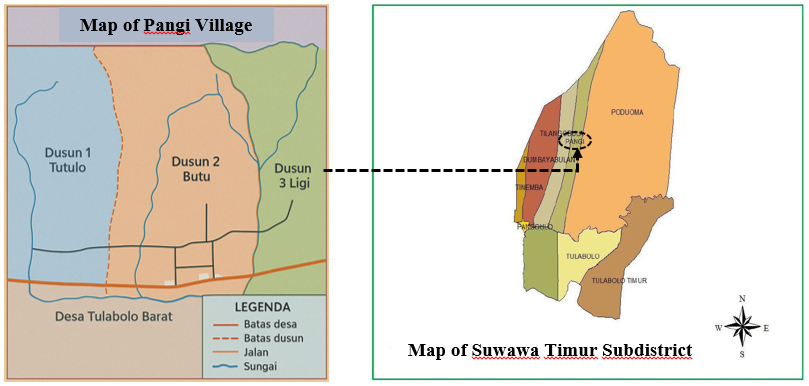
This study examines the socio-economic transformation in Pangi Village, Gorontalo, Indonesia, marked by a significant shift from agriculture to artisanal and small-scale gold mining (ASGM), driven primarily by declining agricultural productivity and increasing economic uncertainty. This study adopts a qualitative research approach to examine the socio-economic and environmental implications of the livelihood transition. Data were collected through in-depth interviews with farmers, miners, village officials, and community leaders, complemented by field observations in both agricultural and mining areas. The data were analyzed thematically to capture community perceptions, lived experiences, and local responses to the changing rural economic landscape. The findings indicate that while ASGM offers higher income potential than agriculture, it also generates significant social and environmental consequences. Social relations within the village have become increasingly fragmented, particularly between households engaged in mining activities and those remaining in the agricultural sector. In addition, mining activities have contributed to land degradation and water pollution, further threatening the sustainability of agricultural practices. Government initiatives aimed at protecting agricultural land and revitalizing the farming sector have not yet achieved optimal outcomes, as they have failed to provide rapid and tangible improvements in farmers’ welfare. As a result, despite awareness of the risks associated with mining, many residents continue to abandon agriculture in favour of ASGM. The findings highlight that the livelihood transition is driven by persistent economic pressures and limited agricultural viability, while simultaneously generating social fragmentation and environmental degradation. This study contributes to a deeper understanding of rural livelihood transformations by revealing how economic vulnerability shapes community responses and policy outcomes. These results underscore the need for integrated policies that strengthen agricultural competitiveness, enhance farmer empowerment, and balance economic development with environmental sustainability to ensure long-term rural welfare.
Downloads
References
Adranyi, E., Stringer, L., & Altink, H. (2023). The impacts of artisanal and small-scale gold mining on rural livelihood trajectories: Insights from Ghana. The Extractive Industries and Society, 14, 101273. https://doi.org/10.1016/j.exis.2023.101273
Adranyi E, Stringer LC, Altink H (2024) Joined-up governance for more complementary interactions between expanding artisanal small-scale gold mining and agriculture: Insights from Ghana. PLoS ONE 19(4), e0298392. https://doi.org/10.1371/journal.pone.0298392
Alam, S. (2026). Tracing livelihood transition through tourism: A qualitative analysis of Hunza Valley in the post-Karakoram Highway era using the sustainable livelihood framework for tourism. Dynamics of Rural Society Journal, 4(2), 116–133. https://doi.org/10.37905/drsj.v4i2.148
Baddianaah, I., Tuu, G. N.-Y., & Baatuuwie, B. N. (2021). Livelihood implications of artisanal gold mining in farming communities: Insight from the Wa East District, Ghana. Ghana Journal of Geography, 13(3), 85–120. https://doi.org/10.4314/gjg.v13i3.5
Banchirigah, S. M., & Hilson, G. (2010). De-agrarianization, re-agrarianization and local economic development: Re-orientating livelihoods in African artisanal mining communities. Policy Sciences, 43(2), 157–180. https://www.jstor.org/stable/40835796
Bansah, K. J., Arthur-Holmes, F., & Assan, E. (2023). Climate induced transformation of agriculture to artisanal mining economy in dry regions. Journal of Rural Studies, 99, 11–19. https://doi.org/10.1016/j.jrurstud.2023.02.005
Bogdan, R. C., & Biklen, S. K. (1982). Qualitative research for education. Allyn & Bacon.
Bryman, A. (2004). Quantity and quality in social research. Routledge.
Cartier, L. E., & Bürge, M. (2011). Agriculture and artisanal gold mining in Sierra Leone: Alternatives or complements? Journal of International Development, 23, 1080–1099. https://doi.org/10.1002/jid.1833
Caulfield, M. E., Hammond, J., Fonte, S. J., Florido, M. A., Fuentes, W., Meza, K., Navarette, I., Vanek, S. J., & Van Wijk, M. (2021). Unpicking the inter-relationships between off-farm livelihood diversification, household characteristics, and farm management in the rural Andes. Frontiers in Sustainable Food Systems, 5, 724492. https://doi.org/10.3389/fsufs.2021.724492
Creswell, J. W., & Plano Clark, V. L. (2018). Designing and conducting mixed methods research (3rd ed.). SAGE Publications.
Fanthorpe, R., & Maconachie, R. (2010). Beyond the ‘crisis of youth’? Mining, farming, and civil society in post-war Sierra Leone. African Affairs, 109, 251–272. http://www.jstor.org/stable/40785323
Golar, Basir-Cyio, M., Rusydi, M., Bakri, R., Bohari, Pratama, M. F., & Laihi, M. A. A. (2019). Gold mining and its impact on agricultural land, public health, violation of the law: A study on Poboya traditional mining, Palu, Indonesia. Indian Journal of Public Health Research & Development, 10(10), 924–927. https://www.indianjournals.com/ijor.aspx?target=ijor:ijphrd&volume=10&issue=10&article=184
Hajdu, F., Rigg, J., Bergman-Lodin, J., Fischer, K., Marquardt, K., Khatri, D., Leder, S., Varley, G., Chiwona-Karltun, L., Sandström, E., Bartholdson, Ö., Engström, L., Beckman, M., & Alarcón, C. (2024). Rendering smallholders social: Taking a social relations approach to understanding the persistence of smallholders in the rural Global South. Journal of Rural Studies, 111, 103432. https://doi.org/10.1016/j.jrurstud.2024.103432
Herdiyanti, H., Suyanto, B., & Mas'udah, S. (2025). Subordinated Ecologies and Livelihood Transformation in Post-Mining Bangka Belitung: Community Dynamics in a Post-Extractive Landscape. Society, 13(2), 675–691. https://doi.org/10.33019/society.v13i2.826
Hilson, G., & Potter, C. (2005). Structural adjustment and subsistence industry: Artisanal gold mining in Ghana. Development and Change, 36(1), 103–131. https://doi.org/10.1111/j.0012-155X.2005.00404.x
Hilson, G. (2016). Artisanal and small-scale mining and agriculture: Exploring their links in rural sub-Saharan Africa. IIED. https://www.iied.org/16617iied
Hilson, G., Zolnikov, T. R., Ramirez Ortiz, D., & Kumah, C. (2018). Formalizing artisanal gold mining under the Minamata Convention: Previewing the challenge in Sub-Saharan Africa. Environmental Science & Policy, 85, 123–131. https://doi.org/10.1016/j.envsci.2018.03.026
Iqbal, K., Liang, H., Alam, S., & Asif, M. (2026). Environmental health experiences in prolonged displacement: A systematic scoping review of challenges and interventions in low- and middle-income countries (LMICs). Dynamics of Rural Society Journal, 4(1), 20–40. https://doi.org/10.37905/drsj.v4i1.88
Kumar, V., & Khunger, S. (2025). Rural development in Haryana: Gender dynamics, infrastructure, and agricultural progress. Dynamics of Rural Society Journal, 3(1), 61–76. https://doi.org/10.37905/drsj.v3i1.43
Li, H., Liu, J., & Chang, W.-Y. (2024). Influence of self-identity and social identity on farmers’ willingness for cultivated land quality protection. Land, 13(9), 1392. https://doi.org/10.3390/land13091392
Ma’mun, S. R. (2016). Pertambangan emas dan sistem penghidupan petani: Studi dampak penambangan emas di Bombana, Sulawesi Tenggara. Sodality: Jurnal Sosiologi Pedesaan, 4(3), 274–280. https://doi.org/10.22500/sodality.v4i3.14437
Mabe, F. N., Dauda, A., & Owusu-Sekyere, E. (2023). Artisanal small-scale mining, farm labour attraction and household welfare in Ghana. Resources Policy, 86, 104208. https://doi.org/10.1016/j.resourpol.2023.104208
Macháček, J., Schlossarek, M., & Lindagato, P. (2022). The livelihood of artisanal and small-scale miners and awareness of the use of 3T minerals in Rwanda—A case study in the Rutsiro District: A qualitative assessment. International Journal of Environmental Research and Public Health, 19(19), 12570. https://doi.org/10.3390/ijerph191912570
McCarthy, J., Meredith, D., & Bonnin, C. (2022). You have to keep it going: Relational values and social sustainability in upland agriculture. Sociologia Ruralis, 63(4), 588–610. https://doi.org/10.1111/soru.12402
Mimba, M. E., Mbafor, P. U. T., Nguemhe Fils, S. C., & Nforba, M. T. (2023). Environmental impact of artisanal and small-scale gold mining in East Cameroon, Sub-Saharan Africa: An overview. Ore and Energy Resource Geology, 15, 100031. https://doi.org/10.1016/j.oreoa.2023.100031
Mkodzongi, G., & Spiegel, S. (2019). Artisanal gold mining and farming: Livelihood linkages and labour dynamics after land reforms in Zimbabwe. The Journal of Development Studies, 55(10), 2145–2161. https://doi.org/10.1080/00220388.2018.1516867
Okegbade, A. I., Adejumo, T. J., Omonijo, D. O., & Okunlola, O. B. (2021). An investigation of the effect of different levels of nitrogen fertilizers on yield of rice varieties in tons. Universal Journal of Agricultural Research, 9(1), 13–21. https://doi.org/10.13189/ujar.2021.090103
Oladele, O. I., & Patekile, N. (2026). Disaggregating household food insecurity access scale indicators based on climate change impacts among smallholder farmers in KwaZulu-Natal Province, South Africa. Dynamics of Rural Society Journal, 4(2), 81–91. https://doi.org/10.37905/drsj.v4i2.98
Omonijo, D. O. (2026). Igbo Cultural Values and Indigenous Entrepreneurship in Nigeria. African identities, 1–22. https://doi.org/10.1080/14725843.2026.2616274
Omonijo, D. O. (2025). Igbo cultural heritage and entrepreneurship development in Nigeria: a qualitative examination of enabling habits. African Identities, 1–16. https://doi.org/10.1080/14725843.2025.2514206
Omonijo, D. O., Obiorah, B. C., Uche, O. O. C., Anyaegbunam, M. C. Shaibu, A. O & Ogunwa, C. E. (2017). Exploring Social Theories in the Study of Insecurity in Contemporary Nigeria. The Journal of Social Sciences Research, 3(7), 59–76, URL: http://arpgweb.com/?ic=journal&journal=7&info=aims
Peters, K., & Richards, P. (2011). Rebellion and agrarian tensions in Sierra Leone. Journal of Agrarian Change, 11(3), 377–395. https://doi.org/10.1111/j.1471-0366.2011.00316.x
Poignant, A. (2023). Small-scale mining and agriculture: Evidence from northwestern Tanzania. Resources Policy, 83, 103694. https://doi.org/10.1016/j.resourpol.2023.103694
Pokorny, B. (2019). The gold for nothing? Impacts of mining on rural livelihoods. International Journal of Rural Management, 15(1), 45-62. https://doi.org/10.1016/j.worlddev.2019.03.003
Prescott, G. W., Maung, A. C., Aung, Z., Carrasco, L. R., De Alban, J. D. T., Diment, A. N., Ko Ko, A., Rao, M., Schmidt-Vogt, D., Soe, Y. M., & Webb, E. L. (2020). Gold, farms, and forests: Enforcement and alternative livelihoods are unlikely to disincentivize informal gold mining. Conservation Science and Practice, 2(3), e142. https://doi.org/10.1111/csp2.142
Sari, M. A., Abbas, A., & Rahmad, D. (2013). Dari petani ke penambang: Perubahan sosial ekonomi di Jorong Koto Panjang, Nagari Limo Koto, Kabupaten Sijunjung. Jurnal Ilmu Sosial Mamangan, 2(1), 15–21. https://doi.org/10.22202/mamangan.v2i1.1368
Schwartz, F. W., Lee, S., & Darrah, T. H. (2021). A review of the scope of artisanal and small-scale mining worldwide, poverty, and the associated health impacts. GeoHealth, 5, e2020GH000325. https://doi.org/10.1029/2020GH000325
Singgalen, Y. A. (2022). Livelihood transformation through the existence of mining and tourism industries: Case of North Halmahera District, North Maluku, Indonesia. Aristo, 10(2). https://doi.org/10.24269/ars.v10i2.4674
Siregar, E. S., Adawiyah, R., & Putriani, N. (2021). Dampak aktivitas pertambangan emas terhadap kondisi ekonomi dan lingkungan masyarakat Muara Soma Kecamatan Batang Natal. Journal of Education and Development, 9(2), 556–561. https://journal.ipts.ac.id/index.php/ED/article/view/2791/1781
Stokes-Walters, R., Fofana, M. L., Songbono, J. L., Barry, A. O., Diallo, S., Nordhagen, S., Zhang, L. X., Klemm, R. D., & Winch, P. J. (2021). “If you don't find anything, you can't eat” – Mining livelihoods and income, gender roles, and food choices in northern Guinea. Resources Policy, 70, 101939. https://doi.org/10.1016/j.resourpol.2020.101939
Teku, D. (2025). Geo-environmental and socio-economic impacts of artisanal and small-scale mining in Ethiopia: Challenges, opportunities, and sustainable solutions. Frontiers in Environmental Science, 13, 1505202. https://doi.org/10.3389/fenvs.2025.1505202
Unruh, J. D. (2005). Land policy reform, customary rule of law and the peace process in Sierra Leone. African Journal of Legal Studies, 2(2), 94–117. https://brill.com/view/journals/ajls/2/2/article-p94_4.xml
Wiroto, D. W., Duengo, W. N., Ibrahim, R., & Rahmatiah. (2023). Aksi irasional dan keseimbangan sosial dalam perubahan sosial akibat penggunaan mesin pertanian modern pada pengelolaan sawah. Dynamics of Rural Society Journal, 1(1), 42–59. https://doi.org/10.37905/drsj.v1i1.16
Widiono, S., Melia, J. J. S., Sukiyono, K., & Serawai, B. A. (2025). Between reciprocity and agrarian transformation: Challenges to land tenancy and labor relations among rice-farming communities in Lahat Regency, South Sumatra Province, Indonesia. Dynamics of Rural Society Journal, 3(2), 159–170. https://doi.org/10.37905/drsj.v3i2.107
World Bank. (2019). 2019 state of the artisanal and small-scale mining sector. Washington, DC: World Bank
Wu, Z., Chen, H., Zeng, T., et al. (2024). Risk preference and rural livelihood transitions in the hilly and mountainous region of southern China: A case study in Ruijin City. Sci Rep, 14, 25482. https://doi.org/10.1038/s41598-024-77356-z
Zakari, S. (2026). Identifying the causes of food insecurity and household coping behaviors in Southern Niger. Dynamics of Rural Society Journal, 4(1), 70–80. https://doi.org/10.37905/drsj.v4i1.92
Downloads
Published
How to Cite
Issue
Section
License
Copyright (c) 2026 Sahrain Bumulo, Rauf A. Hatu, Dare Ojo Omonijo, Dewinta Rizky R. Hatu, Ridwan Ibrahim, Sainudin Latare, Rudy Harold, Marsela Madi

This work is licensed under a Creative Commons Attribution-NonCommercial 4.0 International License.




.png)