Tracing livelihood transition through tourism: A qualitative analysis of Hunza Valley in the post-Karakoram Highway era using the Sustainable Livelihood Framework for Tourism
DOI:
https://doi.org/10.37905/drsj.v4i2.148Keywords:
Culture Fading, Hunza Valley, Information Capital, Karakorum Highway, SLFTAbstract
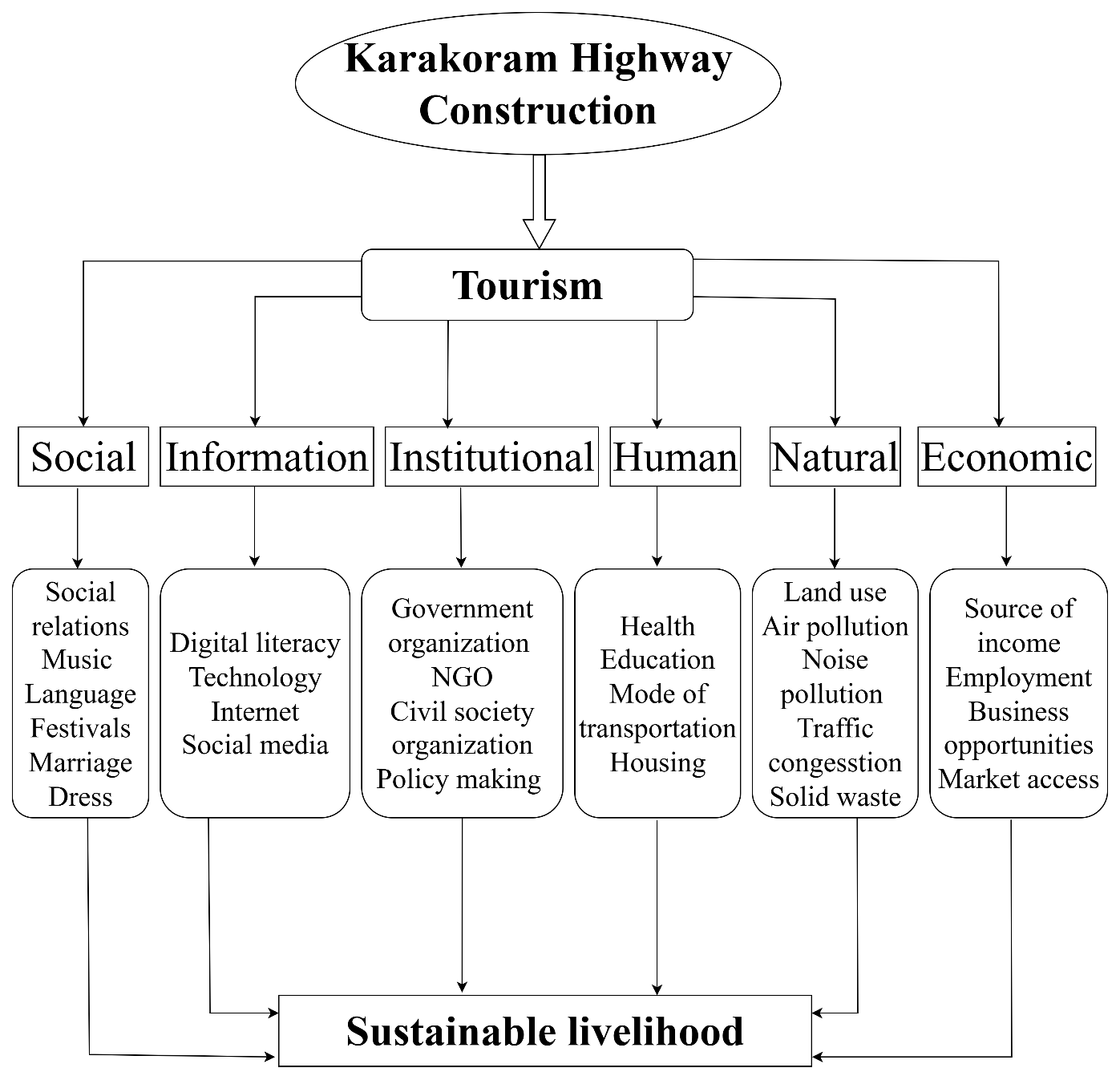
This study examines how construction of the Karakoram Highway (KKH) has influenced the livelihoods of residents in Pakistan’s Hunza Valley (HV) through tourism growth, using the Sustainable Livelihood Framework for Tourism (SLFT). Although transport infrastructure such as the KKH can generate economic opportunities, these effects remain underexplored in the literature from a localized and multidimensional livelihood perspective, particularly in tourism contexts. Using a qualitative design, the study draws on in-depth interviews and field observations to assess changes in human, social, natural, physical, financial, institutional, and informational assets associated with the KKH and subsequent tourism expansion. Fifteen semi-structured interviews were conducted between June and September 2025 and were complemented by systematic field observations in central, lower, and upper Hunza. The findings indicate that while the KKH has expanded economic opportunities, it has also created trade-offs across livelihood capitals; for example, financial gains have often been accompanied by pressures on natural and cultural assets. Notably, the study identifies information capital as a critical emerging resource that enables residents to increase tourism-related income, attract visitors, and adapt to rapidly changing market dynamics. Consistent with prior SLFT-based research, community responses vary depending on social relations, resource availability, and gaps in policy implementation. Sustainable livelihood outcomes therefore require tourism planning that meaningfully involves local communities and policies that balance economic development with cultural sustainability and environmental protection. The study contributes to tourism scholarship on mountainous regions and offers recommendations for infrastructure development that is sensitive to local livelihood patterns in developing economies.
Downloads
References
Alam, S., & Iqbal, K. (2025). Contours of connectivity: Socioeconomic transformation and local perception of China-Pakistan Economic Corridor (CPEC) in upper Hunza, Pakistan. FWU Journal of Social Sciences, 19(3). https://ojs.sbbwu.edu.pk/fwu-journal/index.php/ojss/article/view/4799
Ali, A. (2023). Estimating the recreational value of mountain tourism to shape sustainable development in Gilgit-Baltistan, Pakistan. Journal of Cleaner Production, 426, 138990. https://doi.org/10.1016/j.jclepro.2023.138990
Ahebwa, W. M., & van der Duim, R. (2013). Conservation, livelihoods, and tourism: A case study of the Buhoma-Mukono community-based tourism project in Uganda. Journal of Park and Recreation Administration, 31(3), 96–114. https://js.sagamorepub.com/index.php/jpra/article/view/4112
Anwar, S., F. A. Khan & A. Rahman. 2019. Impact of Karakoram Highway on land use and agricultural development of Gilgit-Baltistan, Pakistan. Sarhad Journal of Agriculture, 35(2), 417-431. DOI: http://dx.doi.org/10.17582/journal.sja/2019/35.2.417.431
Arifin, S. R. M. (2018). Ethical considerations in qualitative study. International journal of care scholars, 1(2), 30-33. https://doi.org/10.31436/ijcs.v1i2.82
Bano, T., & Khayyam, U. (2018). China-Pakistan economic corridor and apparent socio-cultural transformations in Hunza Valley, Gilgit Baltistan Pakistan. Transylvanian Review, XXVI (26), 6969-6977.
Bibi, R. (2020). Local community perception towards the socio-economic impact of tourism development: A case study of Hunza Valley (MPhil thesis). Pakistan Institute of Development Economics (PIDE), Islamabad, Pakistan.
Braun, V., & Clarke, V. (2006). Using thematic analysis in psychology. Qualitative Research in Psychology, 3, 77–101. https://doi.org/10.1191/1478088706qp063oa
Braun, V., & Clarke, V. (2021). One size fit all. What counts as quality practice in (reflexive) thematic analysis? Qualitative Research in Psychology, 18(3), 328–352. https://doi.org/10.1080/14780887.2020.1769238
Buhalis, D., & Amaranggana, A. (2014, December). Smart tourism destinations enhance tourism experience through personalization of services. In Information and communication technologies in tourism 2015: Proceedings of the international conference in Lugano, Switzerland, February 3-6, 2015 (pp. 377-389). Cham: Springer International Publishing.
Camilleri, M. A. (2018). The tourism industry: An overview. In Travel marketing, tourism economics and the airline product (Tourism, hospitality & event management). Springer. https://doi.org/10.1007/978-3-319-49849-2_1
Chowdhury, T. A. (2021). Applying and extending the sustainable livelihoods approach: Identifying the livelihood capitals and well-being achievements of indigenous people in Bangladesh. Journal of Social and Economic Development, 23(2), 302-320. https://doi.org/10.1007/s40847-021-00163-z
DFID, D. (2009). Department for International Development. Trading for Peace–An agenda of Reform.
Gurung, L. (2012). Exploring links between tourism and agriculture in sustainable development: A case study of Kagbeni VDC, Nepal (Master’s thesis). Lincoln University. Lincoln University Digital Thesis.
Guest, G., Bunce, A., & Johnson, L. (2006). How many interviews are enough? An experiment with data saturation and variability. Field Methods, 18(1), 59–82. https://doi.org/10.1177/1525822X05279903
Harold, R., & Wiroto, D. W. (2023). Dampak sosial ekonomi pembangunan Gorontalo Outer Ring Road bagi petani di Desa Talulobutu Selatan. Dynamics of Rural Society Journal, 1(1), 20–31. https://doi.org/10.37905/drsj.v1i1.8
Hussain, A. (2019). Transport infrastructure development, tourism, and livelihood strategies: An analysis of isolated communities of Gilgit-Baltistan, Pakistan (Doctoral dissertation, Lincoln University).
Hussain, A., Fisher, D., & Espiner, S. (2017). Transport infrastructure and social inclusion: A case study of tourism in the region of Gilgit-Baltistan. Social Inclusion, 5(4), 196- 208. https://doi.org/10.17645/si.v5i4.1084
Hussain, A., Mandić, A., & Fusté-Forné, F. (2024). Transforming communities: Analyzing the effects of infrastructure and tourism development on social capital, livelihoods, and resilience in Gilgit-Baltistan, Pakistan. Journal of Hospitality and Tourism Management, 59, 276-295. https://doi.org/10.1016/j.jhtm.2024.04.017
Hussain, K. (2016). Experience and status of tourism in Gilgit-Baltistan. Tourism, Youth Affairs, Sports and Culture Department Government of Gilgit Baltistan, Aga Khan Rural Support Program Skardu, Baltistan Division.
Hussain, W., & Khan, M. A. (2024). Climate change-induced Glacial Lake Outburst Floods in Hunza Valley of Pakistan: an assessment of indigenous farming community perceptions and adaptation. Environment, Development and Sustainability, 26(5), 11515-11539. https://doi.org/10.1007/s10668-023-03396-6
Iqbal, K., Hongcheng, S., & Liang, H. (2025). Conflict-induced displacement in Pakistan: a sociological study of lived experiences of involuntary migration among Afghan immigrants. Discover Social Science and Health, 5, Article 6. https://doi.org/10.1007/s44155-025-00147-y
Iqbal, K. (2025). Multifaceted roles of Afghan women immigrants in Peshawar beyond their precarious legal and social status. Discover Global Society, 3, Article 90. https://doi.org/10.1007/s44282-025-00241-1
Karim, R., Muhammad, F., Salman, A., Shah, A., Qureshi, J. A., & Nilofer, M. (2020). Impact of China–Pakistan Economic Corridor on local economy and tourism development: Case of Hunza, Gilgit-Baltistan, Pakistan. International Journal of Economic and Environmental Geology, 11(4), 14–17. https://doi.org/10.46660/IJEEG.VOL11.ISS4.2020.509
Karrar, H. H. (2020). In and out of the shadows: Pakistan–China trade across the Karakoram Mountains. In Shadow exchanges along the New Silk Roads (1st ed., pp. 22–43). Routledge. https://www.taylorfrancis.com/chapters/edit/10.5117/9789462988934_ch03/shadows-hasan-karrar
Karrar, H. H. (2022). The geopolitics of infrastructure and securitisation in a postcolony frontier space. Antipode, 54(5), 1386–1406. https://doi.org/10.1111/anti.12828
Kumari, R., Boerma, B., Ahmed, R., Suman, S., Sharma, S., & Dhawan, S. (2025). Assessing economic and livelihood impacts of water hyacinth utilisation in rural India: A mixed-methods study. Dynamics of Rural Society Journal, 4(1), 60–69. https://doi.org/10.37905/drsj.v4i1.96
Ahmad-Khan, A. (2022). Geography, accountability and capital: An ethnography of ecological accountabilities in Gilgit-Baltistan (Doctoral dissertation). University of Glasgow. https://doi.org/10.5525/gla.thesis.83259
Kreutzmann, H. (1990). Tourism in the Hindukush-Karakoram: a case study on the valley of Hunza (Northern Areas of Pakistan). In Proceedings of the Second International Hindukush Cultural Conference (pp. 27-37).
Lasibey, A. A., Flora, V. A. S. M., & Taimenas, E. (2023). Analysis of digital media literacy among tourism stakeholders in the coastal area of Kupang City. In A. Azizah et al. (Eds.), Proceedings of the International Conference on Applied Science and Technology on Social Science 2023 (iCAST-SS 2023) (Advances in Social Science, Education and Humanities Research, Vol. 817). Atlantis Press.
Magaldi, D., & Berler, M. (2020). Semi-structured interviews. In V. Zeigler-Hill & T. K. Shackelford (Eds.), Encyclopedia of personality and individual differences. Springer. https://doi.org/10.1007/978-3-319-24612-3_857
Marwat, S. U. K., & Faryal, A. (2022). Ecotourism and its socio-economic impact on Hunza Valley in Pakistan. Pakistan Languages and Humanities Review, 6(2), 1192–1204. https://doi.org/10.47205/plhr.2022(6-II)100
Mbaiwa, J. E., & Stronza, A. L. (2010). The effects of tourism development on rural livelihoods in the Okavango Delta, Botswana. Journal of sustainable tourism, 18(5), 635-656. https://doi.org/10.1080/09669581003653500
Moazzam, M. F. U., Rahman, G., Ali, K. S., et al. (2023). Spatio-temporal snow cover change in the early twenty-first century using improved MODIS dataset: A case study of District Hunza, Pakistan. Climate Dynamics, 60, 3417–3433. https://doi.org/10.1007/s00382-022-06498-5
Mwongoso, A. J., Sirima, A., & Mgonja, J. T. (2023). Impacts of tourism development on residents’ quality of life: Efficacy of community capitals in gateway communities, northern Tanzania. Applied Research in Quality of Life, 18(5), 2511-2539. https://doi.org/10.1007/s11482-023-10196-7
Muhammad, P. (2011, January 30). Hotel industry: Tourists needed, no bookings necessary. The Express Tribune. https://tribune.com.pk/story/111030/hotel-industry-tourists-needed-no-bookings-necessary
Qutoshi, S. B., Ali, A., Shedayi, A. A., & Khan, G. (2023). Residents’ perception of impact of mass tourism on mountain environment in Gilgit-Baltistan, Pakistan. International Journal of Economic and Environmental Geology, 12(4), 11–15. https://doi.org/10.46660/ijeeg.v12i4.68
Rana, A.U.R. (2014). Position paper for draft tourism policy: Gilgit-Baltistan. Washington, DC: USAID FIRMS PROJECT.
Ritonga, A. K. (2023). An Analysis of English for Tourism, Digital Literacy, and Business Success to A Tourist Destination Promotion. Jurnal Iqra’: Kajian Ilmu Pendidikan, 8(2), 325–339. https://doi.org/10.25217/ji.v8i2.3377
Robinson, O. C. (2023). Probing qualitative research interviews: Theory and practice. Qualitative Research in Psychology, 20(3), 382-397. https://doi.org/10.1080/14780887.2023.2238625
Rubin, H. J., & Rubin, I. S. (2005). Qualitative interviewing: The art of hearing data (2nd ed.). SAGE Publications. https://doi.org/10.4135/9781452226651
Shah, A., Ali, K., & Karim, R. (2024). Assessment of peri-urban land dynamics using GIS remote sensing: A case study of Hunza City in Northern Pakistan. Modern cartography series, 11, 315–328. https://doi.org/10.1016/B978-0-443-15832-2.00013-7
Shen, F., Hughey, K. F., & Simmons, D. G. (2008). Connecting the sustainable livelihoods approach and tourism: A review of the literature. Journal of Hospitality and Tourism Management, 15(1), 19-31. https://doi.org/10.1375/jhtm.15.19Get rights and content
Suntikul, W., & Dorji, U. (2016). Tourism development: the challenges of achieving sustainable livelihoods in Bhutan's remote reaches. International Journal of Tourism Research, 18(5), 447-457. https://doi.org/10.1002/jtr.2062
Yang, J., Zhang, T., & Zhang, L. (2024). Research on the influence of digital penetration on the entrepreneurial behavior tendency of rural residents in tourism. Environment, Development and Sustainability, 26, 25549–25567. https://doi.org/10.1007/s10668-023-03695-y
Downloads
Published
How to Cite
Issue
Section
License
Copyright (c) 2026 Sunana Alam

This work is licensed under a Creative Commons Attribution-NonCommercial 4.0 International License.



.png)